
The Protest of Romance is a series of short essays or philosophical memoirs soulfully written during my college years. It is raw and finished with a total of 191 sections.
The Protest of Romance
Written from 2016 to 2019
***
[1]
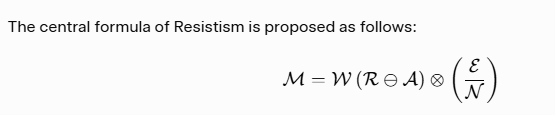
M denotes Meaning
W denotes Will
R denotes Resistance
E denotes Authenticity
N denotes Nihilism
Analytically, this formula maintains fidelity to Resistism’s premises by privileging process over stasis: existence remains “incomplete,” with meaning as a dynamic containment of essence. It rejects teleological finality, as geung-ji (noble pride) implicitly integrates over the equation’s temporal horizon (∫M dt≈G), signifying “the pride of being un-uprooted after a tempest.” Courage, as a multi-dimensional construct with constituents of objective, intentionality, fear, and risk, may be subsumed as a coefficient modulating R, ensuring tenacity’s “inexhaustible energy” sustains the operation against nihilistic decay.
[2]
自殺 à
The virtue of human life as a free agent is in the default mode of negation and denial; the capacity to confront the present allows a reason to live for the changeable future; human is meaningful due to his volition or power to self-actualize and self-emancipate. Meaning of life must be created and never be searched for discovery. Those great poets and writers who committed suicide were simply defeated for the first time. And I praise all the beings who were lost but never defeated. I must demur lionizing the act of taking one’s life, in accord with Camus’ argument in L’Homme révolté, because all the sweetness about death dies together with his death; it is a confession of his completion as well as his limitations. After all, it is ultimately better to live than to die. The harrowing force of conquerors—let them be the theatre of the absurd, fear of totalitarianism or tyranny of the majority—shall never be successful to conquer the vigor of a living spirit that resists. Therefore, a living soul possesses an impugnable soul full of potency and gusto which remain always superlative and unconditionally meaningful at any moment. I alone rule my fate happy.
[3]
Poetry is death and Death is poetry. Death is a peculiar feat. It is a return to permanence that we left at birth. In our time of finitude and divergent materiality, death is a conclusive seal on our creation and is welcome under a mutual concept that it is the final termination. I lament a bad death, a death by accident not by adventure, unpremeditated death which was not embraced by the authors, a death which fills the eyes of dying with fear and regret. This is a nasty, repulsive death or a grisly murder. At various times in one’s life, he must ponder about how to die beautifully, how to conclude his story with artistic urbanity without losing the richness of his worth. It is a question about how to complete himself, the obstinate pursuit of his individuality. Thus, it is a feat of imagination and artistic destruction. Death is, however, peculiar because many find the prospect of death distressing and unfortunate. For those who bemoan at a funeral, what they cry for is not a dead but a deteriorating sentiment lively felt to those alive. Who dies beyond his means? The mortal just fulfilled his mortality! The topic which I have been intensely obsessed with is not the nature of death but a mortal’s attitude toward death, a shockingly beautiful force beneath a silent human madness when it comes to finality, art for the sake of art and romance for the sake of romance. When a man finally understands that he will determinately perish, and it is well noted, whichever behavior comes after reflects his immortalized essence. FATALITY! A war continues within himself between moral-rational and poetic-aesthetic to define him as a creature of value or as a creature of conflict. A man of this tension has to challenge the impossible in the purest form and with a strength of mind for winning the eternal, which nobody dares to emulate but only intensely admires. William Shakespeare, Walt Whitman! Kim Soo-Yeong! Dylan Thomas! William Ernest Henley! Yun Dong-Ju! This is to say, making art out of one’s life.
[4]
Will is nobler than truth. Common truth is a farce to intellectuals because speaking about truth is like a beggar wanting for money with a jaunt mask. I trust more on a savage than a priest, for they honor their moment with sincerity and authorship. A human without will is disqualified as a human being (人間失格); by the guilt of trespassing the Way of Human (人道), he sentences his death. Sadly, truth is powerless, especially when its uniqueness is duplicated for alternative interpretation. Its impotence is reviled by worshippers for salvation because the truth is decisively decadent, unprogressive and obsolete. Truth is useful in a top-down relay of power, preserving conventional and customary norms for consolidation of community-making and their convenience for exerting influence. For the development of an individual, it is a poison. The truth of any kind is like a drop of blood in the ocean which instinctively attracts a gam of sharks from miles away; whose blood it belongs to is hardly in question as long as it is witty enough for appearance of wisdom. Truth is a will leaked to the world; whose will it belongs to does not matter to whom the truth is dispersed because ultimately truth is decided by their will. Will is internal and deterministic, locked in the chest of mind to exercise its complete possession of being and ego. It is also untouchable, unmalleable and pristine; it only responds to our call like a well-trained hound. It is so powerful that any captivating, bewitching thought can be turned into a steaming engine of life. Yes, Monsieur, it is the magic in us.
[5]
Redacted
[6]
Romanticism is the intense, fearless propulsion of will power and unalloyed expression of inner consciousness which uphold the genuine value for a meaningful life (primacy of values). In viewing of man’s nature, a resistant recreates reality according to his metaphysical value-judgments of his mode of existence through a faculty of volition. A power of volition is evidently in the willingness to accept the wrongs of the present and to resist, with the last strand of might, for a meaningful present. The eternal comedy of existence in the recurring waves of uncountable tragedy is in the unanswerable condition of human existence to the question of why he exists. A great majority is troubled by the anxious desire for certainty and purposefulness of a thing that makes the being inherently pursuable to its attainment and achievement. They believe, it is impossible to be meaningful without the attainment of certainty. However, being radically free in the condition of being, under no supervision but self-legislated commands and individual choices, any reason for explaining the purpose shall be doubtable. He ought to be the abstract projection of his intent as the author responsible for debauching a plot. The condition makes a self be introspectively characteristic; definable traits rather than deductive format and logic help explain a being, and such is to take the nature of being as it is. Yet, the existential intellection has disregarded the possibility that a coming-into-being as not a finality but a process and that it is a making of meaning from the ground zero, for we are incomplete beings. Being is nothing but containment of essence, and the precedent-will has to be taken a priori to coming-to-being. Because we are choosing to become a volitional being.
It is generally regarded, fallaciously, that Romanticism is a field of emotion and mysticism. Quite differently, Romanticism, a necessary complement to resistance, is a vindication of will power, individuality and worth, a concept which has to be reintroduced by another definition for rectifying misconceptions—I used the term Romantic Realism. Mysticism, for us, is a kitschy means of savagery from worshipping barbarians and cowed escapists who are afraid to face the reality laid before them. It is nothing but a manifestation of anxiety that is appeased by sheer expression of vanity in the personification of protective psychology; a powerful guardian of good needs to stand by as a symbolic representation of security, even if it is not real. Then they believe what they want to believe. A blind belief without the scrutiny of the analytic approach of its origin through rational exploration is a mere state of self-abandonment and helplessness, and I am not willing to lecture on someone who refuses to help himself or who wants only unearned salvation. When they are disillusioned, like Joris-Karl Huysmans who wrote À rebours (Against Nature), they carried their fantasy in the underground of French Decadence, having been repelled by the banality and smugness of acting humanity. The fashionable despair translated into twisted subversion for gruesome violence and sensual preservation of the moment. Unlike Goethe, Decadence killed beauty and morality at the hill of the 19th Century, the Fin de siècle, but the Fin has lived in a form of labefaction that could not be recovered. Their first mistake is taking an excess as beauty (by unnatural production of decor, artificiality developed and led to weariness from inauthentic continuity and needless superfluity of art) and the second is that beauty has a limit. Hitting a practice to the curve, boredom found its place in labor. It is a disease. By glorifying morbidity, we came to be unknowing of true nature of being vital due to the perversion of nonsense. Metaphorically, it is as sickly and nonsensical as a raped woman glorifying rape. Effete society and enfeebled individuals; they made femme fatales heroines but animalized men. What they call sophistication is a rampageous debacle; their imputed creativity is simply uncontrolled violence or hateful provocation.
True romantic realists explore every fabric of their emotions to know themselves better to be true to themselves. The Emotional aspect has been taken as an easily perceivable symptom of instances for the defining characteristic of his true self and as a guide for a deeper inquiry of his inner world. Without this process, we can never vouch that we have a reliable volition, authentic existence, and true worthiness.
[7]
A spirit of resistance is a sign of a vibrant life of strength and liberty. Holding a value, even if it be the most erroneous, is still meaningful itself, for the insurmountable infinity which makes a holding value seemingly insignificant cannot help but acknowledge the self-evident fact that it exists, against all the odds of being infinitesimal, like a twinkling star in darkness, and it has yet perished. Again, existing is value-making. As we are born in captivity, it is a matter of choosing between resistance and capitulation. At the climax, before rising to a guillotine where death grades a being, we must be worthy of ourselves. When the strength of character is tested, we ought to be able to smile.
The culpability of nihilistic murder must be tried. This is times in which philanthropy smothers millions of innocent minds with a bane of self-righteousness. People start to believe in their cherry-picking truths, perfectly knowing that their truths are imperfect but hating to accept the truth of others, and all conclude that truth, as well as meaning of life, do not exist. This is the age of negation and denial. Today, people are frustrated with the deceitfulness of the world and the absence of reliable truth. And they believe that the new murder, the imaginary murder, the silent murder, is justified, to themselves and others. We then become both nihilistic victims and murderers. We make ourselves distanced from reality as disinterested audience and do not doubt that our opinion is the strongest and the most unswerving. We are disappointed in which there is no higher principle guiding our lives, for we are hopelessly confused. Morality is defeated by the logic of power; there is no just man but a powerful man. We cannot believe in reason because we know very well that our behavior predates reason; we commit murder first and the reason why we did it later. We protest to the silence of the universe but, as our patience wears out, we too easily acquiesce to its silent refusal. At the encounter with the absurdity, we start to clamor, out of fear and infraction, but in silence, we are nervously cowed. Amid protestation, we find a particular truth that our existence is nothing but a will and everything else is just direction of the will. The resistant reasoning understands a revolt as a protester against the criminality of the universe—the crime of neglect and irresponsibility. To protest and revolt, we must exist because our existence is proof of its crime. Resisting, in this perspective, can be the preservation of the proof from the Criminal who wants to vindicate Itself by insufficiency of the evidence. But I thank the mercifulness of time and its containment of values in the take-all system in that deletable end which we submit our values as a crystal. How dreadful to imagine the unending creations, without a single morality, of all new births and new beings, to eternity! Because suicide and murder are packaged together before the existential judgment, our will to recreate ourselves as value-creators must be applied to others in the single package. This is to be said, ontologically, no human is above human (人上人不造) and no human is below human (人下人不造).
I fill a water-dropper, pour it into an inkstone and rub the surface with lampblack; I place my paperweight on the top and bottom and gently soak the tip of Chinese calligraphy-brush into the ink. Full-pressured and breathless motions across hanji with four bold characters:
(Resistism: resistentiam + -ismus).
[8]
Geung-ji is a human quality of noble pride and dignity. A due degree of pride in his moral certainty is necessary to elevate oneself to positive self-evaluation and a sense of confidence. The after-image that we created after our old experience in the past, which we colored as something morally pure, helps make sense of the worth of his work and his life as a Der Einzelne (單獨者) or the only one. Der Einzelne is a man of Geung-ji. Because life is understood only in backward, a man of Geung-ji leaves no trail of regret upon his reflection as he abides by uprightness of himself. Geung-ji rarely derives from past accomplishment per se but from his confidence for manifesting his strong will; the pride of being un-uprooted after passing of a tempest. Existentially, it is a sign of one’s worthiness. His primacy of self and willingness to perpetuate his will go beyond death and toward perfection. A determining quality which avails the system of thought is consistency in a principle. If caprice determines a particular set of qualities, one may be advantageous in fabricating himself in a trend of fashion but there is nothing to be proud of. A cause [goal] and a principle/virtue [means] are inextricably concomitant. There are several things to be cautioned about Geung-ji. The first is vanity (傲慢). A proud man is tempted to compare themselves to others for the sake of tasting the fruit of his power; they say, “I have something that others don’t” or “I can do something that others can’t; thus I am priced higher than those.” When a party is over and a crowd ebbs, he will realize that he is abandoned along with his pride. Geung-ji is not a possession but a state of mind. Also, Geung-ji is a quality for Der Einzelne; it is a state of pleasure from the retention of virtues. Since it is the quality of one individual, a comparison is a breach of integrity and makes him less of a worthy being. You are man in an egg; by breaking your shell to peek outside, you let others to peek into you; they will certainly find your ruination and be delighted to destroy. Knowledge in one’s true individuality and selfhood can give him the irreducible fact of himself, and one’s perception of himself is everything of value.
[9]
Commonly speaking, rationality is a toolbox for self-interest. A student of resistance takes a slightly different interpretation by perceiving himself as a moral agent of rationality who strives for the self-substantiated truth. Persistence on ungrounded belief is incorrigible bigotry. The constitution of rationality always accompanies with well-founded moral codes of conduct and thought. The overall decline and retrogression of humanities into primitive epistemology of mysticism are frustratingly dampening and reproachful. It is a sub-animal art of self-delusion and rhythmic frenzy of savages. A culture of collectivist practices and rituals induce spurious selflessness and repetition of affirmed guilt that renders individual values neglected for the good of the many. I say, rationality is nothing but self-interest; individualism of any kind is non-sociable and non-negotiable aspect out of reality, for his defense and pleasure, because a man can be truly actionable, without guile, when it comes to his regard for achieving his highest potential. To philosophize is to sit on the throne of a realm without subjects.
[10]
“Invictus” by William Ernest Henley
Out of the night that covers me,
Black as the pit from pole to pole,
I thank whatever gods may be
For my unconquerable soul.
In the fell clutch of circumstance
I have not winced nor cried aloud.
Under the bludgeonings of chance
My head is bloody, but unbowed.
Beyond this place of wrath and tears
Looms but the Horror of the shade,
And yet the menace of the years
Finds and shall find me unafraid.
It matters not how strait the gate,
How charged with punishments the scroll,
I am the master of my fate,
I am the captain of my soul.
[11]
This is D rftiger Zeit and the Age of Turbulence (時代 of 激動), Uncertainty and Destruction. The trend of depravity valorizes odious psychosis and human impotence through vying amongst the artists and writers for a higher degree of mawkishness and misery, and the public believes what is loathsome and baffling which draws a pity and destitution as a higher art because it is irrational work of human psychosis that is unfathomable by common sense. Remember, people tend to glorify what they do not understand from awe of uncertainty. One often sacrifices morality for deeper despair and disbelief; one descends to a theatre of the absurd, relying on the breakdown of communication, logical absence and hopeless silence; the wall of sense and rationality breaks down, and they call themselves avant-gardes or revolutionaries while talking nonsense as the virtue of their work. What is known as a conversation is a compulsive monologue on the same topic. Comte de Lautreamont’s melancholy and fatal doubt led him to destroy the insupportable reality by disowning morality to its primeval stage. He wanted complete destruction of order and mankind. What I see is wickedness born out of unbearable solitude and cathartic desire for violence. It is no revolution but a demolishment of morals and a dangerous experiment of metamorphosing themselves to ugly chimeras. As such, they became no longer human (人間失格). Locked in the chambers of horror, they lost faith in humanity as well as will to remain as human. The modern writers, philosophers, and artists believe themselves as daring whistleblowers of human depravity by shocking the audience with a certain measure of extremity. It is a game of extremity and a recreational wordplay that tests limits of the imagination for human degeneracy. It is all ludicrous entertainment. Yes, an absurd and outrageous entertainment. They are all disqualified. No serious thinker adjusts himself to a popular taste. Art is not a toy. It is a mirror of beyond. Art has a duty to mirror whom we are [realist component] and what we ought to be [romantic component]. Like a fallen fledgling out of a tree, I sense that romance is dying in contemporary art except a few outrageous imitations barely suscitated for the popular art. This terrible ruination, beyond words, is now simply lamentable.
[12]
I often think that no place is reserved for me in the promised land. All mortals commit a grave sin but what truly kills is the sense of guilt (罪責感). And I am a guilty sinner who refuses to be forgiven because through the Sin of Existence I retain distorted humanity in me. I am 理想 of 抵抗. I write words of my lofty ideals and blind myself with their light, being happy about undiscriminating transparency of my philosophy that ruthlessly exposes the unsanctionable part of my soul before the seat of judgment. And I rejoiced amid punishment. I objected to my sin, threatened my sin and eventually compromised with my sin. I am Heathcliff and Dorian Grey.
[13]
Like a well-refined emerald of timeless beauty, existence is art of craft with which the possessor can polishing to the finest degree, through excruciating persistence under a blasting furnace, to make its true color come about and to delight the possessor at last. Things become immediately bearable the moment I accept the challenge, as my will utters no such things that enfeeble my mind but only what I am trained through because I imagine the day of honour and victory. My senses are unified for one purpose. Let me live tastefully with everyday thrills running down through my spinal cord and explode like a restless volcano gargling with lava. Give me pressure, struggle and hope.
In crisis, I thrive.
[14]
Often, the great majority of people find the origin of his being from the shipwreckedness of chance and presumed accident in the work of nature. The accidentality defines all human beings and non-human beings because Nature operates in laws, not in plans. Being as an accidental property of an object is being without necessity, for an essential property is unknown and without definitional characterization of the object. Being accidental contrasts with an essential feature of our being. This discrepancy forces us to question our being with “who” and “why.” Soon, from the inability to deduce the reasons for our essential properties, we define ourselves ontologically insubstantial, void and meaningless. Yet, a belief in accidentality is a false premise itself that can neither be tested nor explained. To me, it is a deliberate omission of the process of coming-to-be with a categorical negative which is succinctly expressed, “it just happened.” Just happened? I am the last person to believe that a thing just happens. Nothing just happens. Nature constructed its law with strict deference to freedom for the actors within to behave with cause and intent to freely exercise its way, in the physical level, for the continuum of will. He is not thrown into a world. He is given the world in a way that it never has or will be. The substantiality of a being is to be created, not to be born with. All the beings in the world express their substantiality in one way or the other, not in-itself but for-itself. Yet, what is unique about conscious being is the existence of will which differentiates from reactive substance to proactive one. This makes a breakthrough possible.
[15]
Ungroomed and starved in wild variations, poetic outlaws shun a life of forced idleness to be misalignments. A cluster of ragged poets lives on the other side of the bank outside of the world which spun them in a comfortable obfuscation because they branded themselves in danger. The danger is their trademark and ingrained habit of identity. The existing society browbeat the perils of their existence, claiming that they are the moral hazards dismantling the foundations of collective stability and traditional values because the bitterness of poetic outlaws is defiantly indigestible. Their rejection of a refinement of the civilized stands out too much and their rudeness intolerable. I particularly like this word, rudeness. When I breathe life into this word and break it through between my teeth, I see red murderous faces heated of disruptive imminence in them to use force for justification. Their hands are clenched and eyes unblinking and mouth quickly babbling in spiral emotions until they finally start to break in prickly hatred. Most of the poetic outlaws shuffle rueful self-abasement and unbearable shame, thinking that they are disgraceful stains of perfect glass, but they will always say they will do what they have done and there is not a speck of regret behind in their creation. They oscillate between the craved quiescence of settled life and the rage against the ‘good accusers’ who left them moldering behind bars. They bubble up again.
In pariahdom and homelessness, they arm themselves with tulips and guns of poetry and the poignant sharpness of mental vista, to fight off a dull, automated life of wonderless civilization. We are eagles dividing the sky, roaring Siberian tigers on Paektu Mountain, falling leaves of a red plum blossom! new maniacs! rooted stargazers! night-walkers! thrillers! And the living legends.
We are inventive and courageous, ceaseless and profound, and wildly unexpected. We challenge things that were conventionally thought formidable, the impossible and unshakeable establishment because we are the antithesis and creative destruction. Being discontent with the limits of his mind and to seek the mysteries of creation, we defy and rebel, to fill the hunger in us and to submerge into inner richness in preparation of the coming war and for nonconformity. Nonconformists, we are, unsolicited, unpredictable, unencumbered, unvested, daring and iconoclastic but not for the sake of destructive ruins but construction toward a better truth, a substantial truth, and innovation. Too much of independence of the nonconformists of unique mind is considered unfitting to the establishment of existing norms and institutions because they cannot be useful functionaries for social reinforcement. Yet, poetic outcasts are reframing the stretch of imagination toward metaphysical beauty and permanence—the greatness. We deliberately detach ourselves from the exasperations and desperations of the moment of mankind. We find it particularly useful to have a burning heart and causes for misgivings and finality…to fill the unlistening void and to chastise a comfortable livelihood.
[16]
A history is a chronology of exaltation for the victors in a contiguous domain of glory. Why is only the voice of victors reverberating through the hall of fame? Simply because the other side is silenced. Look at backstage behind the bloody curtain and see the bleeding men fallen from iron fists, gasping for another breath, only to be slain their necks off to join the stage as the scenic pile of corpses under the heavy feet of victors. Bards will sing the legend of a glorious battle, and the dead cannot hear it. Nevertheless, fortitude bears a virtue in rejecting regression and in projecting against the formidable walls of oppression. History in the authentic sense belongs to losers and bearers who have nothing to lose but to procreate their wanted history. The children of failure rise next day to rage for another failure, for the better failure, in the finest novelty of human resolution that refuses a bare acceptance, until they put a banner on the roof of history; now the history favors the least favored; the children of failure are now the children of change. The cyclical trade of history between the oppressor and the oppressed is ever sickening to swallow as the sentience of the former is locked with the latter in the zero-sum metaphysical game: the greater the pain of the oppressed, the greater the oppressor’s world. The collectivity is influential to its belonging individuals and the originality is no longer a cognizable substance of the argument.
If shattered, piece yourself together. If fallen, put yourself up. If beaten, return it seven times harsher. I drag a coffin with a chain around my neck. I cannot wish to die anymore. I must protect this coffin. I must. Against all the odds that front me disfavor, I must be resolved to march steadfastly on my pathway until I prove it right. Every new step is step forward. Even if millions of companions depart and should I march alone, I march alone. I walk a narrow uphill that many do not dare. Resistance is dauntless audacity of the lesser against the greater through a will to suffering—the essential quality of existing—because suffering most clearly evinces the will-power of the sufferer. History is the story of ‘I’ as observed and evaluated by ‘me.’ When the history is written by my hands, I will fear nothing and live as if I am the history.
[17]
A ghastly chaos clouds a swerving road to the madness of passion, provoked to writhe himself tormentingly, with the equal tension of alertness being wary of every closeness that constructs the imaginary boundary of innerness and outerness, of me and others, that finally enclose the pores of exchange. One may think himself, “I am a mediocre man, a speck of dust, a smudge, a worthless cockroach crawling over a corner of the earth, eating scanty and sleeping plenty…” Such man will consider revolutionaries a species of another kind and mystics of the century; resistants are willing to suffer eternally to the value they commit; if they must die for it, they will happily die for it.
[18]
A bored antihero sustains himself at the minimal level of desire—basicness—in a stream of tedious consciousness and rotational operation, spitting, cussing, shrugging and yawning at every instance of life with apathy and indifference. He is a superfluous man whose soul is unshaken by nothing but a gluey awareness that he is sinking, meaninglessly sinking, into a muffled void. He is turned into a ravenous gambler waiting for a fortune of entertainment—wanting for sleeping, smoking, drinking, and sex—to cloud his consciousness from forgetfulness and self-alienation. He discarded himself in the world of unapologetic strangeness and became an alien to himself. Nothing seems real or touchable, and the meaning of reality is constantly disintegrating within the inner city of nihilism painted with a color of apocalyptic greyness and piecemeal atrocity. It is learned helplessness, invisibility devoid of stimuli and temperature. The frozen sea starts to crystalize under his feet and cracks his body. He lives in misery, in intolerable hatefulness of his mediocrity. What torments him is the memory of warmth, the romantic greatness, and inexhaustible spirit. He believes that he is too corrupted, too ailed and too calculating to restore his faith in human greatness. No, it is to restore faith in his greatness.
But he knows that his tablet is buried at the bottom of his heart. He lost it at some point after business of living. He doesn’t know when or how. But it is there, still there, somewhere down there. A fire that is still unextinguished even in the deepest valley of the ocean. All is required is a spell of category, the aged imperative, the Name. Call the name, command your authorship, pound the wall and fire a volley of rage
At the existential battlefield, it is either to be or not to be. It has no place for boredom. It is all illusion, fatigue of prolonged battle against time and being. At the height of human accomplishment, a human actualizes a fundamental drive to be nuanced and evocative of a theatrical texture and stage between conflicting values of novelty and normativity. An existence is transformed into the essence of an art form, that is, rebirth. When what is conventionally and consciously rejected is re-embraced for acceptance, the antithetical catharsis transforms two polarities into a singular dramatism of continuity through the process of subversion. When the subversive valences of performativity are tuned into a consistent power of existence and thus meaning, existence becomes an art, the art of ratified strands. A fabric of existential life is in becoming of resistance, in new usefulness of acting and elevation. His life is a turntable of metaphors, poetic individualism and performativity. Textures and qualities of his life are articulated through virtues, moral choices, aesthetics, and poetic existence. Exhilarated for life, a man will walk out the door to engross the freshness of the world to exclaim, to conquer and to beautify. Behold the world which I will make after my lordship and authenticity.
[19]
In the conditional command for the categorical self-legislation, a consciousness of a subject ought to be epistemologically dissociated and dissected into two from one—intro to the Singular-Plural Thesis—to balance one against the other, that is, one who invokes the categorical imperative to command must also invoke another self who is categorically bound to obey within oneself: when one feels victorious, at the same time, one feels defeated. The impetuosity claims within oneself following one’s propensity to ratiocinate for what is best suited to his wishes and correct determination. A disposition which impels and commands the self to act purely in respect to the self-legislated duty recognizes, in its signification of worth, not the moral worth, but the worth in compliance to his command, that one has overcome his fragility and impurity of humans nature through his power of will, and that his worthiness derives from its achievement based on the compatibility that is drawn between the two selves which command and obey. The power dynamic exists within oneself, for a singular being has to act in two ways. The inclination to act upon draws a contestation of two competing self-interests between justification to act and justification to rest, between a law and a willingness. We operate in the covert impulse of self-love whose expressions diverge in multifarious forms and motives of two conflicting principles because a self-legislated principle forcibly subjugates the other principle in an extended battle of claiming the moral worth. There is no self-conceit or false presumption unless the dominant morality intends to hide and put the defeated morality to the front face for the experiment of acting to maximize the benefit—a worth—of self. Spoil for the triumph of inner battle is the right to moral claim. In this sense, our actions need not conform with duty since expression itself is dubitable of its intrinsic value. As a result, humans have to make a compromise between the two devils—the submission of double or double coincidence of wants—to find a common ground for objectivist legislation of self for the individual moral worth, that is, a will of its own. Whenever there is a necessary reason independently of all appearances to actualize a command as legislation, it is the job of the morality of the imperative to persuade the willingness of the obeying regardless of which nature the obeying possesses and how imminent and contradictory it is, to be qualified as a volition of its own authenticity, and that is a law without a force.
[20]
We are the kind of beings who cannot resign ourselves in failure or accept absurdity at the present state of reality. Our attitude to life is essentialized to an insatiable desire for freedom and to which our eyes are inextricably fixated for the moment of actualization. Crafting a fine art out of life itself is an attitude toward perfection. The direction of our living should always be in a counterattack, from forbearance to open rampage, that is, a reversion of state of mind from a victimhood to an authorship. All signs are in our favor. This is a good time to fight.
[21]
We have more faith in a sick man than in a healthy one because his truth is purged by suffering. It has been traditionally perceived that gravity, awe, and elegance are found in individual suffering itself as it is likely identified as the art of undoing of human depravity. Suffering may be a precondition for an enduring humbleness, but it is far from perseverant one that renders our lives sincere and authentic; the true cinematic beauty of life is found and recognized in human struggle, not suffering. Suffering is intrinsically reliant on the external recognition of your bearing of pain while the struggle is evaluative and emergent from your internal volition to fight against the pressure and challenge.
[22]
Read slow and live slow, my friend. A resistant can enjoy himself despite everything conspires to negate it because he is the creator of his joy and happiness.
[23]
Resistance no longer concerns itself with the -ism of one school with another. It only subscribes to the poetics of self-realization. We refuse to accept the demagogic pride, with a celebratory air, as the goal of resistant aspiration even at the illusory level of which we enjoy for momentary confidence. Let us not confuse ourselves with the self-deceptive notion that the trails of resistance will be left for honorable glory to other followers to imitate the walk of pioneers. It is our goal and new poetics to disappear. We will not disappear into nothingness; we will disappear into everything. As we resist and resist hard, history will remember us.
[24]
I envision the day to come when I can ungrudgingly confess that I have finished the long fight and fulfilled my professed duty. I shall say, I did what I had to and what I loved. For the use of my youth and passion, there would be nothing to regret. My worthiness will bloom in replete happiness and dignity of authorship. When I retire and languish myself, I shall say, “Do you see honorific scars on my forehead of which time has slain? I fought with time for timeless things.” I will lose to time but will win timeless things. And hopefully, I can look up to the Sky and remark, shamelessly, that I did my best. Do I deserve to return to ash and dust?
[25]
The greatest form of retaliation is not loving your enemy but ignoring them. Indeed, hatred toward unlikeness is a natural contract by the exchange of antagonism balanced by the equal or greater hatred as a reactionary composition. A sense of mutuality legitimizes the hatred as a safety valve for himself: by hating others he does not have to hate himself. However, unless he feels the necessity for immediate and complete retaliation, it is favorable, for serving the psychological interest of position, to ignore his enemy who despises him: a disregard will earn him the superiority of consciousness by disqualifying his enemy iota of worthiness of his attention—not to say of his hatred—and the recipient, his enemy, is forced to gnaw on the bitterness of being erased by the worst to a mere-nonexistence, as something inferior to the worst. This is how you dethrone your enemy. Hatred is a negative desire for human touch. In hatred, you are compelled to recognize the existence of others and give full credits for the justification of your hatred: through hatred, your hateful enemy starts to live in you. Disregard is eviction of your enemy out of your mind, your world because you decided that he is unwelcome alien without a visa.
Yet, it is philosophically arresting to hypothesize that the origin of violence is a need for unignorable recognition from others, in that he finds peculiarities, passions, and foibles of whom he confirms, both likes and dislikes, for the objective assessment of his being. However, the objectivity of others is fantastical and chimeric because it is mediation for self-consciousness. The mutual recognition in social estrangement is simply an expression of objectified subjects: the other subjects become objects of his subject. By use of violence, he finds comfort of equality from alien others, a certain companionship, and distorted self-love because in others he finds himself. If others are only considered as mirrored subjects of his subject, confirmation from others is self-assessed and less assuring of objective validity. In reality, the subjects of others are essential subjects, not objects, and thus objective assessment is impossible. The use of violence intuitively understands the existence of other subjects that are unidentical to his own subject. I believe, the most desirable reaction from others, as equal subjects of unknowable nature, is belligerence and pugnacity; in tacit contract of mutual violence, he can ungrudgingly use his force, being forced in return, to test each other’s nature for objectivity, while fully acknowledging its impossibility. This is the flourishment of absurd recreation of beings. And it is undoubtedly a madness.
[26]
We are whom who admire. Far should it be prescribed in the superstition of power or hierarchy of authority in which the ascension and decline in the history of human standing have gravitated. Admiration is not a currency of prestige but is a moral of self-actualization, since its essence naturally rejects the distasteful pursuit of unaccepted, unreasoned, and unworthy likeness which he sets no mind to. The mind is abducted to the brilliance of the future whose lingering residue irritates over the achievement of the higher value. The mind indefinitely expands with the ensuing of unmitigated pleasure. In the face of abject ruins upon the disenchanted reality of absurdity, a hero leaves a footprint of a romantic impression in a quixotic dream of reaching the unreachable and touching the untouchable, of happiness and greatness. The man knows no fear and never succumbs to obstacles, and it is the man who is moved by self-legislated destiny for greatness—the unexpected heroes born in an inopportune time. The mighty mind explodes at rewriting of the saga. A chant plays at the opening of a new tale of an untalented boy in hankering for greatness.
After all that sense of loss, I still live in the memory of the first taste.
Then, one demurs that essentially a society is entertained by the theatre of heroism, and in strict individualism of existence, without others, it is only a narcissistic struggle. There is no hero in a lonesome existence. A man lives in a shred and contradiction of duality between his splendid uniqueness out of nature with a grip of eternality and condemnable body of contemptible smallness, transient but delightfully comfortable to rot into the disappearance. This density and finiteness! Laughable yet strangely estimable quality of certitude from his inner drive in the making of his world. O this ambiguity, O this duality, O this weakness. O human! O human!
[27]
It is neither about a sweetling fairytale of wild imagination nor a heightened sensitivity to promises of life nor abortive elation of sorrows and dreams from abuse of impressionability. It is rather an intently writhed extract of hope and stroke of empowerment, a new smoking cloud of thought and cynical counterpart, showcasing a recreated reality fitting to an artist’s taste and reason by honoring his volition. Realism and romanticism are two sides of a coin. Romantic sentiment in the past had been, not without legitimate justification, criticized as a mood of the lawless despot. Their eccentricity is wild and indefensibly contagious that their conquest of heart and force of emotions are commonly cautioned, for a political beast has often sacrificed and appropriated his art for his gain. Romance as a characteristic of human beings is latent in conditions of human existence. A romantic existent should be thought in a dualistic and dichotomous aberration that he is a rational in the irrational world and an irrational in the rational world. For a romantic realist, the sole binding logic of rationality is objectivist self-interest. The rest is a matter of architecting words of reality whose objectivity consists of individual subjectivism. Making reality conforming to his will through a work of imaginative creation of values is intrinsically and uniformly romantic. It is what Jacques Barzun called “solving epoche.” A romanticist temper, by a differing degree of subjectivity and original genius, is unique and individualized. Intrinsic romanticism is a human constant as if each human being is born with a unique lyrical tune and music. To a romantic realist, emotional gymnastics and hyperbolic symbolism are lesser importance than a mental growth vis-à-vis self-interest in pursuit of a strong becoming. Making of existence requires a brutally intensive tonality of life embracing both poetic amorousness and virulent contradictions within oneself. It is a process of elevating one’s life through struggle, through agony and ceaseless doubt and self-denial, for his knowledge is uncertain and unknowable to man. Yet, interwoven reality and artificial truth notwithstanding, his will is and ought to be absolute. This is where human exactitude is courted against sappy mysticism and force of circumstantial irrationality. We march to uncertainty, not to indulge ourselves from opium of sentiment, but to test our will in the unknown and to find ourselves in total self-reliance. My heart is palpitating with joy and excitement. I yearn for beauty and freedom.
A realist is sensibly aware and fully cognizant of a set of external determinants of standards—which I coin as conditioners—which bear a constitutive relationship of survival because morality is adaptable trait of self-interest, or shortly to put, to moral realists like Philip Kitcher, morality is adaptation for maximizing his inclusive fitness by coordinating his behavior. I must most impassively object to the belief that morality is an adaptable trait of self-interest and that moral objectivity is a code of illusion foisted in our genetic. The undeniable truth is that realist is the most adaptable, for he can mask himself under any camouflage or a caprice of social consciousness by unabashedly belying himself completely innocuous, parasitically, to any acceptable social norms with which none can disagree; it is the most strategically advantageous way to hide himself in a crowd as a spy, for human tends to befriend with those who agree with him than those who do not. Is this not Rashomon, Rashomon itself? Yet, I am a passionate romantic realist. For us, the baseline of argument for moral validity or moral truth is, I vehemently argue, singular existence of being. The influence of collective force is necessarily corruptible and inhibitive to a natural spring of passion that is real to him. Real to me, that is all that matters. Such an attitude is driven by existential individualism. Our objective as a realist is to maximize our worth, and our objective as a romanticist is to be foolishly youthful. We are living in this contradiction between calculative self-interest and irrational adventure. We adapt to our principles, principles only, and no other.
[28]
[29]
Humans are such beings whose subjectivity naturally defies enjoyment of pre-established things that act as a binding tyrant of unfreedom which they chose not. It is desirous to trade the autonomy of now for the fulfillment of the implacable demands of justice with a prolonged fortitude and defiance. Fortitude is an ability to sustain the will over a prolonged period without interruption. The resistant constantly challenges himself to the actualization of his capacity to resist in the face of unbearable predicament until it becomes bearable. The man never relies on scorn chances of externality for the revolutionary victory that makes anyhow better but only on the power of his soul. The extenuation of resistance is halted in distension of current punctuality, oblivious of future outcomes and past failure, as the necessity to resist is now, and the rhetoric of resisting changes from ‘need’ to ‘must.’ Although the resistance is born in the insufferable conditions as a reactionary mechanism to the lasting repression, its essence is proactive, inventive, and affirmative; a preventive measure of self-preservation whose vulnerability is exposed is unconsidered for because the sole purpose is perpetuating the will to the extremity at the cost of everything. An enmity and violence for the enemy are a low stance of resistance. Escalation to the high ideals of representing the total domination of his will is the highest pursuit of resistance. A resistance incapable without collectivity is an aggregation of minor forces that are contingent on the physicality of protesting materials. A true resistant will choose the solitary path of defiance against everything. I alone rule my fate.
[30]
Heterogeneity of empiricist moral sentimentalism and existential realist representation opens up a gateway to a new mode of thinking called romantic existentialism, a hybrid neologism that shares essential prepositions with resistance at its core tenet. Its fusional restlessness is pronounced in a lack of belongingness and in high aspiration to ‘contain the eternity in a moment.’ Retention of spirit in modern life for the good of his being requires self-reliance without a mystical force of transcendence. The unknown and unexpected are approached with the most precarity and reason; lifting oneself beyond obvious danger of weakness and digestible reality, is sheer stupidity. It is a common-sense as simple as that you do not open the front door to a stranger. Adventure does not mean escape. It is a responsible quest for survival in a new exposure. An existential rebel insists on the power of heroicized self to overcome the limits of impossibility, for imaginative fullness, by creating a world that it ought to be than it is. A typical romantic sentimentalist may firmly believe that every version of quotidian reality is irredeemably objectionable and that the pettiness of daily life is only obstructive to experiencing a festive buoyancy of spirit. Romantic realism is not from the debasement of the banality of reality but reconciliation with it. Existentially, it beautifies one’s willingness to be present in a continued struggle; a lonely struggle without any help. The resolution in struggle justifies self-interest because the struggle is ontologically singular: no one can suffer for another; one cannot relegate one’s responsibility for his consciousness to another, and the other cannot have a double-existence. The self-interest justifies being an odd and an outcast. His state of isolation and nonconformity, however, is a secret. With the full knowledge of his alienness and distant solitude, an existential realist is a rational strategist who is free from the accepted social convention or the code of modern morals by perfectly melting into a group’s cold spot of invisibility where one hides his thorn under a handkerchief. Being a social outcast does not mean he is a rebel; the title derives from a positivist decision of the ruling society. On the other hand, being romantic in his struggle qualifies him as a resistant, for it is his decision against his condition. Ownership or authorship of his existence is paramount for a resistant. Even if one speaks in an unprofitable tongue and writes in unattractive voice, it is still his discourse and his story of love, however grotesque or unsightly it may be.
[31]
Philosophy of any kind, as it seems, concerning the construction of beauty and truth, has choicelessly employed a form of generalization to explain a certain point of view not so much with its accuracy but with accessibility. The discovery of general truths sounds perfectly oxymoronic. The acquisition of knowledge after a detailed and exhaustive system of investigation defies a world of delimited simplification and simple answers to complex questions. Generalization, however, is a fated illness of human language and a windfall for humanities as it is inescapable fallacy as an alien being that we do not possess a perfect knowledge in anything but a desire towards it; and we are left with full latitude to refashion the uncertainty with relevant interpretation of value and existence which we expand our imagination to answer with appropriate philosophical and artistic generalization. Although the foundation of language, in its structure and use, is to persuade the audience with a certain generality and coherent succession of dependent ideas, the generalization in philosophy is less for persuasion but a decision. For existentialists, it is a necessity, because we have no surgical device to analyze our soul except through meditation and confession. Whether philosophy is accepted or not would be decided by cultural beliefs and values of the time, and philosopher, writer, and artist should be silent to their comments, for they handle the perennial interest of mankind that is represented by all in history than a few in the history. It is also noteworthy that generalization is the expansion of a particular truth to identify recurring patterns in a web of many complex truths whose parallel constitutes a system of knowledge. The narrowness of a generalized view is, paradoxically, the most reflective of the human condition: temperament and sensibilities of a circumstance rather than truth and reason of nature shapes who we are. Art and philosophy are mostly products of passion, and the passion avails humanities to thrive precisely due to the unknowability of truth that allows freedom to exercise our will and to create our truth in the void. Hence, it is a windfall for humanities. It is astonishing, to me, that we are saved by our deficiency and that we created impressive beauty out of nothingness through generalization. Some say, “What can we be certain of anything?” And I added, “Thus we created these.”
[32]
Feet on the ground, eyes to the stars, heart in union with the Superior.
[33]
People often regard a state of insanity as a terrible, crippling state of mind and dangerously aberrant and curiously incomprehensible like contemporary art without a rational basis of aesthetics. They operate outside of carefully regulated spheres of acceptability. Derangement is both celebrated and condemned due to the bizarre mystery of their mind and uncertainty of our heart. Yet, there is no such thing as a true madman. Insane acts which we perceive unacceptable are, in that person’s reality, perfectly natural responses out of rational mind. All the confessions which the madman makes, through pure intellection on the perception which he creates, in a psychological point of view, are within the bounds of possibility and always intelligible. We simply find it unacceptable, that is all. We likely ostracize him because his language is too weighty and too formidable to be conquered by reasoned communication; his wall is too high and the river too deep; the basic ingredients—a logic of the game—used in the communication are too different. We fail to subjugate a madman so we decide to butcher him out of society. Sanity is a different degree of madness, for what we believe as ‘normal,’ ‘average,’ and ‘polite’ are equally hideous and revolting to the madman on his account. People hate madman out of politic of thought and difference of perspective.
[34]
To live is to suffer by conditioning himself to surroundings which he put his heart into. A tacit contract between the existent and the surroundings is bound by his recognition and attention to which he exposes his vulnerability as a conditioned being. A man gives up a portion of his freedom to obtain something to live for. An insignificant one out of an endless multitude of selfsame things becomes significant as the one and only to the eyes of the conditioned. This, to me, is a miracle. And this miracle is called love.
[35]
On the battlefield there is no distinction between royalty, nobility, and commons. It is the law of warfare that losers must fall behind without a say. In the place where the class conflict follows the existential struggle to fulfill the right of ownership which being itself is achieved by himself or by destroying the rights of others. There is no pavilion in warfare unless you are the dead of the past or the unborn of the future. Only children of the present, at the veritable time of inception between the past and the future, can rightfully participate in the act of forging the historical point of the here and now. Becoming an audience is the privilege of fighters, warring participants, warriors, and winners—but those are not the audience. Audience? Audience? How imperious and blind should a man believes that he is excluded from the battleground. Don’t we thrive in crisis?
[36]
We call it the equal who is unassimilated and unemulated to the value of anyone, uncompelled to any force or influence by defining his way of life. Is that what a friend about? Probably friends despise one another while still being fascinated by the other’s defects. Like how a baby wants to touch a fire, we become friends by measuring a harmless distance of warmth where we can perfectly recognize others without truly understanding each other. With friends, we often exchange vulgarity simply to observe how far we can disclose our true nature, but these are all pretension and all falsity. At the end of the day, friends and enemies are just entertainment.
[37]
A farmer can toil harder when a respite is promised at the end of the day and a feat at the end of the year. In the same manner, a human can live ferociously because death is promised at the end. “Teacher, what do you mean by the feat and rest? What is the relationship between?” The teacher answers, “forgetfulness, of every labor and sweats, and of himself in that condition.” Winter becomes bearable by the presence of forthcoming greens, marriage by children, letters by knowledge, urban by nature and canticle by beauty.
[38]
Imagination is the weapon to fight off the impossibility. The power of mirroring disparity, incompletion and incoherence are purported to reject the domain of reality as a mechanism of counter-reasoning untainted by living conditions. Non-actual configuration by the use of metaphysical possibility is taken to guide the perceptual and sympathetic ideation of things that appear to be independent and unviolated. The active imagining actualizes the phenomenological and mental state of being into the form of the capable because its existence by essence deconstructs, resists and confronts the reality, and it is called imaginative resistance. The cognition in the aesthetic value in the imaginative act of resistance is sufficient to incur the fictionality of unwilling to the reality of willing. Humans on the path to the non-avoidance of existing and following tragedy are in a line of convoluted paradox as they are humorously yet passionately played on stage. A human is pluralistic, in multiple dimensions of acts and facts bound us in a tight knot of distortion and reduction.
[39]
Who am I? A metaphysical rebel, a dislodged slave, a rootless sufferer, and an adamant refuser. I question the existential conditions and working of fate in the ruling of Natural Law. We are a species of imperfection and disunity ceaselessly horsewhipped and chased by existential fear and doubt of two incomprehensible things in the human condition, that is, conscience and rationality. These two bound us miserably immutable. It is a tacitly admissible statement of the belonging truth in disguise which compels a man to categorically accept that human nature does not change. Society proliferates, and civilization progresses. But human does not. The very imperfection of existence is called into affirmation at the simultaneous mirroring of others in equal suffering and absurdity which paradoxically allows an impetuous desire to correct the errors of others. The farcy of humanity overflows its capacity. Then we wait for the mercy of time to obliterate the halcyon memories of thoughtless justifications in the coming of deathbed. A metaphysical rebel demands justice, not collectivized but individualized, less for fulfillment to overcome the laws of injustice than for procreation of existential meaning in his living even if the justification is the most erroneous to millions but truthful to one and oneself only. If it is to be a barbarian, I would pleasingly be a barbarian with a sense of respected eccentricity. If insane, let me be insane. Let the iron laws be self-standing.
[40]
Of many living creatures, human has been endowed with an unbearable gift named Free Will to think, believe, and rationalize what is true in his mind, which empowers himself with a power to liberate his action in one direction or the other, resulting the free action depended on the decision of free will. The action is either physical or metaphysical. But the action is meaningful only in negation. When an action is carried out by a free agent, the agent is the forbearer of his action, the totality of his action from its birth to termination, and moral responsibility. The autonomy of his thought carries the agency of accountability in his belief because a collection of beliefs and thoughts is the composition of what he is. By free will as faculty of free intellection and rationalization, no circumstances beyond control can deterministically harness an existential volition unfree and inauthentic, for a free will, as long as it is, is always capable and self-verifiable through metaphysical rejection and rebellion. It is the spirit of non-yielding. Free Will holds its worth by reserving the two options of yielding and unyielding—yielding can be either by will or unwill but non-yielding is necessarily by will—due to its indomitable character to resist against the force that subjects his being under possession and materiality of the creator. The end of Free Will is happiness by acceptance of what his choices have led under the limited conditions provided, bearing inherent worthiness from meaning in his existence.
[41]
An honest man weeps: lo, now perforce distraught with a strain of grief, disheveled in unbounded basin of teardrops, writhed and wretched in torn garb of woes and misfortune, hither I am tearing myself in loath and sadness from usual sickness of my deluded mind and blindness to thy marvelous stature, Justice, whose luster I see no longer. Even from the weakling might of tyrants, bloodhounds of evil-doers, gimmicks of wantons, and falsities of villains, I have piously adhered to true merits of good conscience and a just heart in the lengthy and strenuous path to keeping myself in the highest probity and a fair innocence. (The Highest knowest my truthfulness). Torture me not by the sight of ramparts molesting innocent mothers and children and by the sounds of their perduring wails, screams of death agony, which I witness in absolute powerlessness, deadened in unsoothed ire and rage until a whistle of Death softens their hearts. Have I not defended thy performance in public and private, which I have never boasted myself a word in a dutiful observance to self-effacement and commonwealth, should I bear the due of foul crimes which both honest and dishonest men falsely accuse, at my own expense. Without bountiful recompense of good deeds, unheeded in silence and secrecy, I have claimed no other demand than the stake of justice itself, for a fortune of justice should be your authority and must I be thy obedient servant in faithful compliance to your rightful judgment between the good and evil. Yet, your reticence at the sight of unscrupulous acts of atrocity and perverse malady of wickedness leaves my dwelling totally defenseless to general calamity and destruction. Justice as the endower of complete equality and fairness who rewards the good and punishes the bad, whence is my share and happiness on my living, should I decide to conclude my story, hereby, in a complete resignation? Damage to thy good name, which I uphold as the first principle, is the damage to my existence. Dear the merciest, my living is unbearable from grief and pain. Why doest thou give me innocent eyes and a merciful heart without a power to be just? I find those meaningless and only adding to my suffering: cursed am I from deliverance of my mother’s womb! Let the innocent be innocent and the just be just. O heavenly Justice—glory be thy name—compensate me not with vain fortunes of earth, which is a mere abhorrence to me that disparages the deepest passion of my heart with a few recompenses of goods, to my chagrin, for only due pays of debts from evildoers themselves shall satiate me. End my life or reveal thy splendor upon the earth. If not, I shall die in a rueful remorse, a trifling act of rebellion, which I am capable of as a sad mortal creature.
Then I became Ivan Karamazov
[41-1]
W. H. Auden’s “The Shield of Achilles”
A ragged urchin, aimless and alone,
Loitered about that vacancy; a bird
Flew up to safety from his well-aimed stone:
That girls are raped, that two boys knife a third,
Were axioms to him, who’d never heard
Of any world where promises were kept,
Or one could weep because another wept.
[41-2]
Taking offense at the unachieved justice, when good men suffer and bad men flourish, needs to be examined in a different prism at variance to understand its true nature. If immense concessions should add to the fortune of a good man by virtue of being good, what is the essence of goodness but exchange value, from virtue to wealth, through the estimation of market force and tradable materials? If virtue is convertible to wealth, virtue becomes a marketable material. Having a good man compensated is an outright conviction of his virtue as far as his life continues to be tested. If doing good is a process of being good, he becomes a good man by doing good, and doing-for-the-good itself should be the end of his desire. In other words, he received his award in full by the worth of his being. Being good and having fortune are two separate things that should be counted individually insomuch as a bad man is not always associable with punishment. What is bad? It seems badness is simply a state of undesirable activeness in opposition to goodness. If a good is rewarded and a bad is punished, a will in favor of good is in dominance. On the other hand, if a bad is rewarded and good is punished, a will in favor of bad is in dominance, and the bad will be called good by the new convention. This is just a conflict of two wills for a lead of change and dominance. I see nothing but a tension of disagreement and a competition for power. Good is rewarded because of its superiority and bad is punished because of its inferiority. However, what is truly interesting is that taking offense at the unachieved justice is persisting to the defeated ideal as good and to the dominant ideal as bad. This type of notion is often found in Christianity or Marxism. This is persistence—”a loser’s bigotry”—no resistance. Both dominating and dominated are working under the same logic and desire: they are the inverted equals of the identical root.
Let us examine what is detested by both good and bad. It is neutrality. Neutrals are free, unaffected and disengaged. Their presence alone flatly cancels the logic of power across the board due to their existential uselessness to both powerful and powerless. I at times question any difference between ‘freedom’ and ‘uselessness’ and have never succeeded in finding a satisfying answer. I believe the world has become complicated by the neutrals who never exposed their neutrality. Their disguised intention and unfathomable identity have dramatized the world by having others fear their uncertainty. Neutrals stand outside of boundaries of good and bad. They are true strangers. And probably, they are the true resistants.
[42]
臥薪嘗膽
Vindictiveness proves its execution at the expense of self-harm. As the consciousness precipitates to the bottom of the psyche, the intoxicating ecstasy of life is reduced to a single intention of exterminating the other with the greatest pain. Vengeance is an active resentment to repeal the past evil by fulfilling a vicarious pleasure from false imagination that justice to the catastrophic event of an individual’s life can be carried out through a volition to retribution. A will writhes in gnashing of teeth and snares of wrong, in recognition of impossibility to turn the outcome in reverse of time and the conversion of life’s joy and happiness into doom and frustration. A soul whirls in the vortex of revenge. As the old saying goes, it is lying on the brushwood and tasting the gallbladder. In the suppression of anger, his heart gnaws on the freedom of rationality as it clouds his head with a smog of combustion. Being revengeful takes a sweetness from being a redoubtable nemesis of a singular purpose: disproportionate retaliation! The gouged charge of which he demands is a total, definitive and irreversible extirpation of his enemy at the price of his totality. He becomes fearless. He drinks fire day and night. Into the clarity, he slowly turns into madness. He starts to live in extreme of thoughts and behavior, until he achieves his goal. Yes, he rides in preparation, blood-tear in his eyes, and never tires.
Let the greatest retaliation befallen to our enemy and let there be no apology. Let us remain unforgiving and patiently whet our blade and grind our axes. I bought this wrath. When a devil comes to collect his due, I will pay the interest with the dead body of this man and the rest with mine. And the devil will dig two graves for us. At the end of the day, we will be regretful together. But at least this man stands next to me. Remember that the suffering has been given the divine right to determine the extent to which the retribution is performed unto his enemy through his exorbitant investment of suffering. Lao Tzu resorted to the Heaven’s Net (天網恢恢, 疏而不漏) in Chapter 73 of Tao Te Ching, a wisdom in which the Sky’s Net, though it may seem to be uncouth and full of holes, It seamlessly works and never let the sinners go. Wouldn’t it be a natural inclination of all men who lost a great deal due to the unforgivable atrocities of the sinner, that I drive myself into delirium of fire and break the wings of this sinner and mine as well? Did the Heaven give a new life to my most loved and a right to choose her timely death? How terribly unjust! Look, I chose my vengeance, so let me suffer through it.
[43]
I am a soul of unconquerable youth and exuberance, sailing forth across the vastness of the ocean, measuring the distance between stars and fathoming the depth of high tides, to find the path of my own where my mind set to. We voyagers explore the uncharted seas of possibilities! When warm, ponderous night stretches its silent teachings across these hours of contemplation, a wanderer’s song is sung beyond the intangible horizon, in joy and at times tears, over-pouring serenity of darkness. Forlorn is the sea but romantic is our nautical existence. Upon the deck is a little world of ours in the oceanic cosmos—bound yet free. Who are we: the children of voyagers and captains of our destiny! Ahoy! Aboard and embark!
[44]
I posit a warning to a legion of dullards and coxcombs senselessly uttering manufactured words of mob wisdom, uncontested and unoriginal, whose absurdity is self-replicating by echoes of senseless men who vulgarize the human spirit and vigor as means of exchange values and as morals of low animals. Mob wisdom, the unpardonable bogus and excrement of perilous experiment, is to make one will more evident, louder, and stronger for a collective effort to justify their insanity through a repetitive group indoctrination, in which the second thought is impermissible, and to tame the fools who believe the gilded words real and without fallacy; in such rule of insanity, justice is farce and docility is virtue. In such an assembly line of equalization of thought, whether it be benefiting or harming, a human is reduced as unfree cogs of the machine, a pack of hungry wild dogs, worthless cockroaches, losing all human expressions but satisfaction and repugnance. By the stronghold of vociferous opinion, the mob reassures themselves blameless in a stifling provincialism: if right, the mob force is justified, if wrong, nobody shall dare to accuse. If the mob wisdom is proven wrong, since what is feared cannot be ignored and should be either submitted to or destroyed, for the sake of being the strong, the truth will be deliberately distorted in their favor. No dissent from an individual as whole merit any consideration retaining a picturesque value to accomplish the better truth. Since it is impossible to rectify what the mob thinks they are already right, everything is true and nothing is wrong. In such a case, truth loses its meaning since there is no way to verify the truth true. Mob wisdom is the worst form of all evils because it deprives humans of reason and means to find better truth. Even if the truth is open, it will be untrue to individuals who do not believe the truth. Then, the truth loses its meaning to the individuals, and the individuals care not whether it be true or false. Hence, the truth must be individualistic and always be searched for individuals, by individuals, for the individuals, to be authentic.
[45]
I first met Johann Wolfgang Von Goethe in his masterpiece, The Sorrows of Young Werther, and I became completely infatuated by his writing. I had to kneel and worship his genius, for I felt a thick liveliness that restored my faith in love for humanity. I started to trust my heart and all the feelings it has to come to fruition, with all the strength and desire, as intensely as I can, so I can love again. I have been so absorbed with the narrowness of my heart that it can only be reconciled with mankind through the affection of a woman, and probably only one and once. I realized I have put stakes on that fertile soil of my youth, killing all the pleasure which I can taste of, both bitterness and sweetness, misery and happiness, so I can bemoan over the barrenness of heart for my old days. I do not mean that the pursuit of my love is the love for humanity. A trifling pleasure of the Arcadian which was soaked out from the deep sea of heart should not be quelled by a caprice of insolent ruffian so much as that a nervous misery should be experienced by that heart alone because we disapprove of the unhappiness of man like a contagious illness while envying the happiness of others. Does a man need others? Why can’t a man live by himself? Maybe he does. I shudder at the insecurity of my dislodged heart whenever I look at the haggard man in a mirror and wonder what love can possibly be in that man. However, looking at the other side of the heart claiming that there must be someone whom I can love, I sneer at myself. After all that disappointment, I still yearn to restore my faith in humanity.
[46]
Of all forms of desires, happiness is the greatest without condition which, by its thought alone, enlivens men from the fatigue of living. Happiness frees the possessor from strings of existence by actively affirming one’s life as a whole meaningful and worthwhile. Ethics of happiness undertakes two moral virtues, contentment, and gratitude, as instruments of living full whose use can be either a confession of happiness or pretension of being happy. Attuning one’s life in subscription to happiness seems to lead inherently delightful and promising living, by its equivalence or proxy, to one’s well-being. Yet, men are obsessed with being happy too much that tortuous struggle for happiness makes the men unhappy. Resistants flatly reject the flagged preposition of happiness as the either emotional or self-reported state of contentment both imperfect and deceptive, for a good life is an active life in abiding by internalized laws of high morality as utmost priority whereof the happiness is a byproduct of worthiness. Rather, to me, the end of a good life is art, as a common rule for men to endow value to their existence by performing their lives as if their lives are a work of art. To live well is to live theatrical in his genre in yearning and earning of his worthiness. Histrionic is historical. Replication is death for artists. Perfection is law. The show must continue.
Two most pursuable things in life beyond happiness are beauty and virtue. A virtuous life is a good life that makes a human life worthy. Of all virtues that are compared, the most foundational one is fear, which gives birth to essential virtues like courage and love to be cultivated for higher ones. Without fear, it is impossible and unnecessary to practice virtues since constituting virtues consistently is motivated by fear of losing human qualities or of worthiness which makes a living meaningful. Another necessarily pursuable thing is beauty which is the ultimate end of life and death by making those two insignificant and annullable free from roots of fear and by rendering those two as mere ingredients for existing more dramatic and theatrical craft that is presentable to the Audience. The greatest beauty is in both human crisis and human of crisis as they are facing each other in dynamic creation of the highest art out of human existence, something out of nothing, in similitude to divine qualities, supreme and godly.
[47]
Living properly (昭志) is a state of living in perfection. The concept should be holistic yet coherent in an intelligible way that fits together whose embodiment necessarily penetrates through the moral constitution of worthiness. The underlying kernel of its function ought to be framed in purely motivative kind of strict unconditionality so far as those are imperatives of human interest independent of external rationality. These laws are self-evident and thus sovereign in expression. The articulation of using these virtuous elements to aim for realizing harmony is well-intended but violates the basic principles of resistance as of freedom of strict individuality and of non-conditionality. Concerns with the subjectivity of interpretive framework in realizing the virtues which create contradiction and conflicts are from an abstract assumption of universalizing a particular for all without considering the voluntaristic side of human agency, that virtues are creative by and possessive of the performers, not the outsiders; in such sense, individuality is upheld and maintained. Yet, certain linearity can be drawn in defense of its characterization that these are dearer than life itself, for the moral disposition to do good can be one determinant for an existential reason. One practices propriety by eating properly, sitting properly, walking properly or resting properly; in every aspect of life, a touch of perfection needs to be performed for a principled living.
Be mindful of this above all: be virtuous yourself. After all, in the walking of nights, this fool bears himself alone. All men are born great but die on the way. But a virtuous never dies but once. In his felicity is the soundness of mind to accept the contorted reality and to procure his dignity in its purest form in a high crisis. Strength is in resistance. Burn at the moment but pine for else. It’s time to rise and rise high.
[48]
I rather aspire to be a tree that endures the whirling tempest than ears of rice that lower their heads.
[49]
Owning a peace of mind amid struggle is fullness by itself. In union with the perfect serenity, a mist of fear is lifted, and doubt subdued, for a clearer vision of what ought to be done. Placate yourself in total equilibrium. Living to oneself and in the present is being in the scene in which one belongs as if the moment is vanishing in a second before and after and as if one’s existence is valid only in between. Thus far, I encountered four activities that a human can do in the time of trouble to reclaim oneself at ease: Worship, Prayer, Contemplation, and Meditation. The maturity of a soul is measured by the depth of silence that he consumes. Worship and Prayer are in substituting of oneself in humble service to the Superior whom the mutual recognition is celebrated by the prayer’s existential worthiness in relation to the divine being, for the two activities necessarily require the asymmetric superior being at all times available as the rational witness who has a perfect knowledge of the situation in which the prayer is situated. The witness by itself is the consolation because, by the Superior, being pitied is being attended whose judgment of the situation lies, for the knowledge of the situation is now in his responsibility regardless of being helped or not. Contemplation and Meditation are self-instructed fiats of his mind to summon the inner strength by either rationalization or simplification. Those two are essential strategies to lead a resistant life that endow a power of resiliency by recovering oneself to the fullest potential.
[50]
A living of a second incised the continuum into two, and the infinite line was disrupted by a single dot. The dot terminated the end of one continuum and commenced the other. Henceforth, a mortal existence bore the value of alpha and omega in its right of existence. Between the alpha [birth] and the omega [death] lies a life. The proximity of two lines attracts one another in a tendency to return to status quo, which is impossible but infinitely pressing. The precondition of suffering is nothing extraordinary or quixotic to a rational mind since it is a self-revealing evidence of existing. Yet, for a rational mind, the revolt of a resistant is extraordinary and rather quixotic because it is, at its surface, completely irrational behavior. Existential resistance is never fully comprehensible, for it is a minor force against the insurmountable one, as reason dictates, “For heaven’s sake, why do you pick a fight that you cannot win?” Because my romance dictates and my will overrules. At this finest moment of now, I only care about testing my will. By what other word can I define my sufferable existence without the word ‘will’. Will is never born without suffering and suffering without will. Craving becomes the essence of being like hunger or lust, and the two precipitate tedium or misery. Metaphysically, it yields to depression of nihilism or insatiable want of happiness. The latter is the most counterintuitive to human satisfaction due to the essential impossibility—the imperfect creature longing for the perfect happiness. The metaphysical desire of hope in the midst of occasional convalescence intoxicates a reasonable mind into a desirous brat. Like salt water, happiness may be temporarily quenching but ultimately makes the desire desperate and exhaustive by elevating its level of reach higher and higher. For a man who only lives by existence, existence itself is an abomination and crime; he is either a moral denialist against wheeling cycles of conditional absurdity or an uninformed participant to the absurdity. A life is concludable as no desirable thing is to be protracted, excepting the fear of death, and such death is always escapist. It is only revealing his own powerlessness.
[51]
Live existentially. This is the primary duty of all living things.
[52]
Drawing more general discussions about human dignity as a concept requires understanding dignity as a state. Dignity as a state which I am referring to is not universalized rights of men that every human is born with. It is a constructive interpretation and measurement of human in richer qualities as something to be achieved and as possession of value. Dignity is metaphysical highness whose qualities are cultivated since birth. It is cultivated and fostered, thus it is respected and admired. The Western philosophers of Kantian tradition have formulated the nature of dignity as intrinsic value or worth which cannot be traded off with the equivalent price of another, treating all humanity as an end and never merely as a means. However, the instrumentalization of the human being is always practiced, inescapably and without choice, as long as there is cognition of another consciousness because of the alienness of being. In Aquinas’ Commentary on the Sentences, dignity means “the goodness something possessed because of itself, utility its goodness because of another.” A peculiar concept behind is that, if all beings are equally dignified to and fro, no one can judge another. If all beings are unequally dignified to and fro, the question remains, from whom and where is the measure of dignity and why should we follow. There we know, competition for dignity is competition for power, only if we concern dignity as exogenously priced by others and for others and when we use the concept for comparison. Dignity is self-worth. The principle of life differs per person when the autonomy of ego-concept claims his right to individuality and authenticity above all the other beings; he is exalted by his worth and kind, thus it is less of ethical mastery but of determinedness of mind for self-conceived justice. This sense of determinedness from ego constitutes the inviolable core of our necessity for being and meaning of life with a distinguished property of continuity by emotional and rational faculty. Dignity is a representation (表象) of will. It is a fatal quality and emanation of unstoppable defiance to a threat of ultimate escalation of the stakes between the possessed and unpossessed. By the nature of infallibility of the quality, accumulation of ‘the asset’ is necessarily unfit for a tradeoff: its construction cannot be offset by other destruction but by himself. The unifying force across all the nations and history, albeit of their incompatible differences, is a drive for greatness that human possesses in the pursuit of meaning which makes a concession and reconciliation possible and likely. Dignity is unformulaic and omnipresent in any par excellence of particularities as long as the greatness is concerned, and the conflict between the greatness is lawless, for it is a finality of things in nature that is essentialized into a nick of time and theatre of the moment.
[53]
I am wonderfully convinced that perfection lies in excess of thoughts and excess of problems. These will devour me and break me down into indivisible particles. And in the belly of the monster [修羅] where I am laid in the narrowest binary of doing or not-doing, being or not-being, I let my instinct to find the perfect answer.
[54]
Singular-Plural Thesis
As such is a gaze of man in two facing mirrors in multiplicity of self in infinite continuum, it brings forth the discernable existential truth that a man is singularly plural and plurally singular not by the conditional status of performance owed to his social duty but by the moment of singular self in the present to live as if a billion of equals are standing behind him. We are not conditionally pursuant of meaning, we but are meaning itself. A transfer of meaning between me and myself is self-reproductive and affirming of Being as I stand infinite and singular; Being itself is inherently given and sharing with other self-being in the division of space, time, and presence. In nihil is the truth of the meaning by being as truth: a being of the moment is the totality of its being in space and time. A man who claims himself of the world which he belongs to is in the place according to the procreative power of being the master of his domain as if the world is he and he is the world. We no longer struggled to possess meaning but are meaning itself; the self-standing meaning as we are impossible to evaluate and in an absolute standard of value in ourselves. Name is simply a representation, and its heterogeneous repetition is indicative of a singular existence. The origin of us is singular but we are plural not in terms of a state or a quality but in the essence of posing as it is. For I am plural of me and myself [being singular plural—being singularly plural and plurally singular], I am dauntless, empowered, and capable of anything and everything. Even if a man alone exists on earth, his plurality remains unchallenged, which I aptly recall the famous lines of Walt Whitman’s:
Do I contradict myself?
Very well then I contradict myself
(I am large, I contain multitudes)
As much as the Creator is distinctively characterized by creation, the creature in so much as being a creature bears the meaning of being-already before recognizing that it is. An action is singularly defined but existence is plurally defined.
It is an existentially significant discovery that there is no ‘other.’ Beings are in affirmative contiguity between us and all-beings of originary interest of consciousness as the world perception is individualistic by his individualistic exposure to and perception of the moment which is irrefutable yet constitutive. Yet, the true originary is the moment in which existence is born and reborn in an incessant manner in creation, procreation, and recreation of self in the nick of time as a right-bearer representative of his idea, that is, dignity. Being valuable is essentially directed to the worthiness of being within; yet, as a being is pluralistic, being-value is directed inwardly as the value exposes itself outwardly. Therefore, ‘being each other’ is inherently synonymous with ‘being myself.’ Without actors performing their duty of representation, no play is ever endurable.
Yes, the plurality is finctionality—it is the quality which we possess in others by identifying them as part of us, as part of our experience by the curious inner voice which we use to explore the differences as if we are the whole. The defective countervoice in our qualities forces us to be nonbinary and doubtful. Let me contradict myself as fully and bombastically as I can to reach the limits of possibilities of all my potential with some of good words and healthy thoughts.
[55]
Bitterly and sardonically, the kind of neurotic pessimism and the kind of passive nihilism have replaced our modern consciousness and have senselessly excoriated our nerves with deadly tumult and chaos. They debase a daily metaphysical introspection, falling to the bedrock of existential meaning, laborious, futile, and abysmal, suckling the self-conjectured austerity of its unfathomed mystery as the justification for non-participation and thereby making the self hopelessly unscholarly of self. A philosophy of solitude independent of self-conceit and vanity makes the discourse of authentic thoughts inherently valid with individual value of reasoning, extricating and disencumbering the reasoners from the obstinacy of spontaneous faith and drastic intellection. My procedure has simplified the basic attempts of self-consciousness which will surely attain the criticism of ignorance and philosophical gullibility. Yet, philosophy is a grim stoical endurance of attempted answers which I positively present to myself. End the psychic-sensuous contemplation for vulgar self-civilization by the erratic magnification of nay-say but sink your soul in submersion of humbled exploration which you can pour your whole being in the reservoir of Awakening.
[56]
Authenticity, the existential probity or veracity, is living in accordance with the individualized truth and abiding by the self-legislated rules of heart. It is to be in harmony with oneself, not with others. An authentic self flatly refuses to cede the reality of his existence to the separate consciousness of others by claiming himself as the rightful author of his own story. An authentic self ceaselessly defends his ethical integrity and his Ways of existing unchallenged and unscathed. It is to be a lord of himself and a slave to his words: eccentric, independent, uncompromising, unsold, and truthful. A clean conscience makes one strong. It is infinitely better to be false to others than to be false with myself. I won’t cry nor crumble. What is to be worthy of myself without my integrity? Who am I without my own rules and identity? Let the world worship me. Probity personified has nothing to lose from the malice of others. Artless candor makes a man self-defensible to the caprice of tone, color, and aura of pressing circumstances which blind him with a false image of insanity. When the world attempt to silence me with a cotton ball in my mouth, injecting hallucinogens into my pumping vein and blindfolding me to show invented illusion, I will bite my tongue to wet the cotton ball with my blood and will cauterize my eyes before my body kills my soul. I will speak out my truth before silence suffocates me and I will flap my wings across the bloody sky until I break my wings. I yearn to be like a weighty boulder, immune to all invasions and unconscious of any impediments by its recalcitrant and adamantine character, which endures decades of pouring stream until its very composition wears out. From a boulder to a pebble, not once it exposes its inner deposits and always keeps its solidity intact. An existential vanguard, that is resistant. In a chamber of raucous clatters and bedlam, noble thoughts and integrity are like wailing echoes of a gong. I demand my freedom of conscience with a mallet on my hand! I know that only I have the right to entitle myself: to thine own self be true.
[57]
While all men hold aloof from the truth and pursue avarice and satiety, we must remain unadorned and unperfumed in our measure and after our fashion, stripping ourselves of superfluidities and possessiveness whose impressions falsely beguile ourselves of what we truly have. Setting his heart upon philosophy is walking straightway, with the unseasoned resolution, on a lone path of mockery and dismissal. We have developed ourselves callous to the inexorable loneliness since the first outburst from the birth. A natal solitude carries along the ponderous garment of a corpse which irrevocably bound us fatally dependent upon desires whose overpowering pressure composes the magnetic nucleus of personalities. Then we realize the awareness of devoid and unfulfilled self who is conscious of ‘I being I’ in the absolute loneliness—the singularity—which will release us only by the decree of the Death. Insidious doubt arises in the vague distrust of the experience of illusion where the unknowable thrusts of crisis bleed our soul. We are tormented but reasons are existential; we are disordered by the ungraspable surreal beauty. We prefer servility to helpless assurance before the overwhelming invasion of inauthentic, alien thoughts. The only retort to this dubiety is resistance by bold faith in self-reliance. Be broken and be outrageous. Be clamorous and be tireless. Be concrete and be definite. This is to live existentially resistant.
[58]
In a crowd of a multitude, people can acquire a sensuous experience and pleasure from shameless sex, boisterous laughter, flushed cheeks and intemperate intoxication whose benignity allows a bliss of forgetfulness from the fear of solitude. For them, chastity and continence are beguiling names for dishonesty. It must be realized that the mania carries a string of dependence for individuals who are incumbent to the force of society which defies isolation from the rest. Such foolishness, even if be rebuked, will never comprehend that what makes one individual endurable is the cultivation of interior solitude whose detachment makes him an inviolable being. The art of life consists in the creation of an original and unique self who enjoys his own heaven in mind. Then we begin to hear the murmurs of the fatherland of the long centuries to grow audible as the rational being internalizes the mystery of cosmic procession as it becomes sublime.
[59]
Misanthropy (人間不信)
When I looked into myself, I saw Arthur Schopenhauer. No, probably more close to Ōba Yōzō of Dazai Osamu, Gregor Samsa of Franz Kafka or Rodion Romanovich Raskolnikov of Fyodor Dostoevsky or Fernando Pessoa himself. When I was younger, I used buffoonery as the final courting to humanity because it gave me a string of connection to the strangeness of the world. It was the invention of farce to deal with its blatant absurdity. And I realized that humans live by deceiving each other with fiddling vanity and contempt. They all act with a common tendency of banal complexity; or should I say complex banality? It makes me feel dejected that all men live up to their lives by faking their heart for a show, and, throughout his histrionic performance, he’s captured by his produce, believing that his heart is unquestionably real. The religious certainty and blind hypocrisy to their feelings, alas, nauseate me like the odor of underground sewage escaping from a catch drain. I cannot love men, nor I can understand whoever is willing to. I see crouching monsters in men, all cruel, hideous and egotistic, which are goggling in readiness to sprout out for unleashing of violence. We are bruised and festered by the monsters in us that make us deadly fear of monstrosity in others, finally believing the phantoms of illusion that come into being by our own deplorable imagination; they become so vivid that we regularly interact to feel ourselves because of their ugliness and intolerable nuisance which give us freedom of contempt. Humans joyously deceive others, without knowing that they do, and they take pride in deceiving others without knowing that they deceived themselves at first. I have pretended to empathize with others, and by acting as if I am their own kind, I was able to hide my true nature. Except for my family, nobody can be trusted. Deep down in his heart, he knows that no one is truly altruistic and no one cannot tolerate the strangeness of others; whoever says otherwise is decking his soul out with a colossal balloon of illusion that conceals his fear of disappointment. It has gone beyond intent, beyond action. He never intends to help others but to excuse himself from introspection. A man stores up his heart with suspicion which no amount of freshness can challenge because he was once fatally disillusioned. He was fatally wounded that his soul is shattered and disjointed. He never knows whether his help actually helped or he was simply answered with a customary smile in return for his participation. Maybe what he wants is just a reason to be self-satisfactory in his ghostly heart. Meanwhile, unlike being a misanthrope full of rage and contempt at the folly of fellow men, I may disdain myself as inferior to others before disdaining others. Look, I am locked inside a metallic cube, being punished for the sin of faithlessness. Like everyone else, I am selfish. Ironically, the consistent truth that humans are selfish makes this world breathable, for I can trust their selfishness above anything. Show me a man without the want of power. Well, let me be clear. Man connects with another man with a thread of trust. It is so loose and fragile, it can be sustained only when both sink their interest to hold the end of the thread. Too loose, it will be lost. Too tight, it will be cut. Ah, now I understand why man holds a thread on one hand and scissors on the other hand. Because, with mistrust of men, men can trust one another.
[60]
In a recluse of my soul, I deliberately starve myself into forgetfulness where I retire deeply into a minimal being. Here I am, completely turning my axis in its unique orbit and gravitating around with the exerted centripetal force of my inner consciousness. I only flame yourself with pricks and stings, solace and anodynes of my philosophy and live in its great name to be true to make myself the ideal end of the literary rebellion. I am fascinated and even touched by the beauty of simplicity. The intentional singleness of life paradoxically reveals the greatness of being; in a simple act, I find profound meaning and my pleasure multiplying. Retaining essentials amplifies values of having them in possession, and their true qualities become ever more vivid. It is wabi-sabi. When I brooded over who I was, the simplest answer was ‘I am I,’ I am here to be ‘I.’ I felt a great sense of affluence of happiness when I found that I, my very own existence, is the answer to most of my questions. The intention of voluntary simplicity is the intention to live with harmony and balance. And I find this one of the wisest principles to rein one’s thought and govern with.
[61]
The force of nihil is popularly conceived as a sentiment of tantalizing nothingness and a lump of the throat. It is a particular feeling of being banished in the wilderness. It is also a feeling of unanswerable detestation and isolation that seep into every crevice of mind, freeze and crack it open, exposing the tenderest part of a soul to the predators of a foul ghost. I discovered a strange contradiction within me who is captivated by the gift of nothingness—peace—and its generous finality but also who is fervently claiming a consciousness of ‘I’ and security of its place. I cherish my existence but detest the existence of others. I know that when I take others as a part of me, the part becomes out of my control and that I am at risk of being colonized by the will of others. Nothingness, however, lies outside of this battle, in a greater battle, because it is a condition. For this reason, I cancel out others and only face the Condition. A struggler in a war of psyche, this draws admiration in me.
[62]
But the hour is at hand for a fresh out-growth of the human spirit, the rebirth of the human soul, with a newly planted seed sprouting, as will freely reaffirms itself anew from the broken arches and ruined plasters of the old temple. This life is entering a new chapter and new verses, the avenue of the spirit is wide open, and here I am, a living, conscious, and uplifted self to resist this day another day. I stretch myself and embrace this universe. I will not dodge a single cast of suffering from this inscrutable destiny. I am I, here and now, strong and naked.
[63]
There is a monster, unspeakably ugly and grotesque in all forms and appearance, which has the least similarity to a human being or any form of the known organism. Its arms are decapitated, legs are decayed, the mouth is sealed, and ears are deaf. Arms are removed to make it inescapable, legs are decayed from chemical exposure, the mouth is sealed to muffle the screams, ears are deafened to cut the alertness. Only eyes are safe to be read off its emotion which evinces nothing but fear and hopelessness. The monster possesses no hint of science or any form of intelligibility. It feels, however, a pain. The monster is indestructible as any part of the body, if harmed, regenerates in no time. Nothing has been successful in killing it and only the suffering intensifies at a new level. The monster finds no existential reason to live and desires to die. It desires to die. It desires to die. Now, tell me, my friend, how can you save this monster?
[64]
A sophisticated mind aware of cynicism of reality shall attest to the horrors of human existence that it is better to be drunk than sober, drugged than conscious, forgetting than suffering, asleep than awake, and dead than alive; it ought to be a permanent character of every man’s secrecy that a feeling of implacable indignation against the Creator persists. We are too occupied with our daily toil for the primitive level of survival with hypochondriacal anxiety, the undiminished burden of futility, and nervous manias in a passing second. Rejoice in abomination and hysterical self-infliction violently alternate as if the ennui and pleasure are cheap thrills of happiness. Labor of hatred bears out of dismay in a complete senselessness of a meaningless life in which men inflict one another to distract themselves from solitary philosophizing, that is, confrontation. Destroying inertia and dispelling lethargy are like knifing water, for its action is overcame by a sense of futility, the greater fear. Trapped in the sickening pressure of the everlasting duality, we isolate ourselves in the non-processing of thought, in docile acquiescence, timidity, and fatal paralysis.
[65]
The boy stood on the high land over a saluting dale and started to burst out of laughter in overwhelming joy of fulfillment. Nobody knows that he escaped. This is a secret. Completely bathed in new air, he victoriously opened his arms as wide as he can and accepted this new invitation. ‘I am a freeman,’ he said. He paced straight for the extreme limit of the land, mounting the freedom’s rough drifting ascent toward vastness. Where should he go? It doesn’t matter. He could go anywhere. A cool breeze gently slid down his blushing cheeks and stroked his hair, creating airwaves of a whale. He bent over and tasted the soil. Then he threw his shoes off the cliff, ran and dived into the air.
[66]
A certain hierarchy of gradation of desire to seize the matter and attainment of every grade of objectification—inanimate to animate—has been marked by insatiable striving, struggle, and dissatisfaction. A cycle of suffering is inescapable as it is the existential condition of human life. Human as a rational animal clarifies the consciousness of being conditioned to use reason for complementing the objectification and, therefore, brings greater suffering. It is an existential hunger of desire for attainment. The desire is the natural regard to animal consciousness naturally expressed to the idea and intelligence, which are profusely useful in proceedings to actions of objects.
Given immortality a desire is taken as a thing of absolute simplicity of meaningless nature which has the precise disputation against the desire to live, toward the will to live, as a metaphysical entrance to existential persistence whose mode flatly refuses the containment of self in the process of attainment. A will exhibited in the metaphysical substratum of human consciousness has its origin in human intellection to indestructibility and the following suffering thereafter which transcends over the standpoint of materialism but only in the determination of self-worth, self-valuation, that are inalienable to the fundamental concepts of moral duties of being, not doing. As a human, the greatest moral duty is to save oneself. If a man can be happy in eternity, the man is then complete.
[67]
Tragedy is the object of contemplation in palaia tis diaphora (a long-standing quarrel) between the ethical and the theatrical. The triage transpires because the primary focus of art is metaphysical, not ethical, while that of ethics is self-worth, the goal of existence; the two are not necessarily mutually exclusive. A dialectic which espouses a descriptive sublimation of thoughts and disciplines, not dissolute, incidental understanding of the actuality, allows the use of metaphorical inventiveness and authorship of irony which points to the creation of poetic subject by what Kierkegaard called “qualification of subjectivity.” By his detachment to the real world, his subjectivity is tuning into the infinite possibility to actualize his substance beyond temporality and materiality of objective limit. He is fixated and iconized as a theatre of the moment and dies in its permanence, its dramatism, and eventuality. The detachment of objectivity is a violation of morals—normativity—because nothing constrains him while he is losing everything. Irony may be inherently negating but its poetic and theatrical constitution is not. Whether we are morally qualified or romantic is a decision to be left for posterity. But, if we can regard a tragedy like a guest as we treat the romance, it is not so bad to be tragic.
[68]
We lost loyalty, strictly speaking, we lost our chance to be loyal. How many of us can handle themselves? Our forefathers carried ethical contention expressed through asserted will and pursuable Cause of great programs that required contributions of many individuals who were genuinely eager on their voluntary basis. Their commitment defined his existence aligning with the Cause. Many philosophers of admirable qualities have found the ‘will to believe’ in the full attainment of truth through the loyalty to the ideal, and, quite foolishly, it is believed to be morally pure. This is a jocular naivety. A man who swears an oath, by his life, rarely abandons his freedom without an acceptable return. He does not swear for a saintly metamorphosis or for a burlesque show of self-righteousness—where is the guarantee that he contributed to the Cause? The lawfulness of voluntarily adopted faith should be taken as it is without pestilence of its ulteriority. Being loyal is a solemn contract to oneself. To whom we swear our loyalty for whichever reason, what we are really loyal to is our word, our esteem called honor and worthiness. I want no glory but only honor. Without wearisome exaggerations, It must be taken seriously that it had been constructed by convention that loyalty is the externally driven principle that has a semblance of internal will the better. It has nonetheless a compelling flesh-and-blood arrangement to establish the principle of non-repetition and non-alteration. Once his word is out and sworn, it becomes a law and the proviso becomes the absolute condition. That is what is to be a sovereign. By invoking promissory utterance of my word, I obligate myself as the governing and the governed whose power of consent lies in me, for I can shape myself in my authority and the normative landscape by binding declaration. Many had insisted the freedom to rule themselves but the most never knew how to rule themselves; they simply wanted to overthrow without a thought of reigning afterward. How stupendously irresponsible. Therein, amid the anarchic existence and degenerative perplexity, regretfully, one wishes to obey and serve a lord. This is the mind of a Commoner(凡人). Otherwise, they justify themselves with fictitious truths.
[69]
I burn myself in the bloodlust of wrath and fangs of derangement. These overtook and consumed me in a relentless ferocity and intense vindictiveness that rendered me a monster [修羅]. The destined right of my birth is to carve my way on the corpse of Nihil and to chew its flesh and digest without mercy. It is far from retribution in desire for justice, which is based on a condition of my conscience to bestow a universal equal extension for a vindicatory capacity. The opposite is true. I have no wish to be fair or to be just. My sole desire is performing a disproportionate retaliation, a total affliction and unforgiving vanishment against the insidious malaise of the Century. To be revengeful is to find a cause of suffering; to be exasperated is to expense the suffering; as my suffering is eternal, so is the revenge. It is not a punishment for a crime for which is to reduce harm into an exchange value by the reception of the equal or greater return. If a being is sufferable owing to absurdity and meaninglessness, I shall use the suffering to fight the two. Of all, it is hunting with a purpose. Into the jaws of Death, I march forward with a pen on my hand. I will dance in the rain, in an empty lot, as the magnificence of the universe, with all the exaltation of sadness, here and eternity. After that with a cup of glory to drink and a reason to be victorious, I am still wrathful to make meaning out of everything. If the universe is void, I dare to disturb it.
[70]
Here comes again a night of shame when I confess to wash the dust weariness of living. I live with a knifed heart, and the pain is so intense that I no longer feel it. I bemoan over the duties unperformed, love unexpressed and worthiness unwon. My heart is plagued with the Imperial Cause in a sea of troubles where I am left fatally helpless. I am a false creation. My sensibility wants walking under a street lamp but my will longs for solitary presence in the darkness. “Son, be shameless to Heaven.” Father, that is impossible. I trespassed the Way of Human (人道) and filled my heart with a poison of 自激之心. Before this candle blows away, I would burn myself as a freeman between the blanks of this unwritten history, as a gently moistened lotus in the shower of twilight, to farewell to my glory. Come, come, my beloved partner. In shame I will fall asleep, thinking I will be awake all night.
[70-1]
“Emerging from an Old Palace One Day” by Kim Su-Young
Why do the littlest things make me livid?
Why am I not livid with that palace and its debaucheries,
but livid that I got a lump of fat for a fifty Won beef-rib,
pettily livid, swearing at the pig-like woman in the sollong-t’ang restaurant,
swearing pettily?
Why do I only hate the night-watchmen
who come calling three or four times to collect their twenty Won,
not once fairly and squarely
demanding freedom of expression
for an imprisoned novelist, incapable of exercising that freedom
in opposing the despatch of forces to Vietnam?
My petty traditions, eternal as now, lie stretching before me,
a structure of feelings.
For example, this happened to me:
When I was in the 14th field hospital in the prisoner of war camp
in Pusan, an intelligence agent, astonished to see me making sponges
and folding gauze pads with the nurses, asked why I didn’t join
the prison police; I ask you, what man would do a thing like that?
Right there in front of the nurses.
What is upsetting me now is just the same
as that sponge-making, gauze-folding.
Hearing a dog bark and surrendering to its cry.
Surrendering to the clamor of a youth, still wet behind the ears.
Even the falling ginko leaves are brambles I must walk through.
I am standing aside; indeed, I never stand right at the top
but move a bit to one side. Yet I know
that standing a bit to one side is a slightly cowardly deed!
So here I am, petty and livid.
Livid with the barber,
since I can’t be livid with the landlord; livid with the barber,
since I can’t be livid with officials high or low in the local government offices;
livid with the night-watchmen, for twenty Won, for ten Won, for one,
isn’t it ridiculous? For one single Won.
Tell me, sand: how small am I?
Wind, dust, grass, tell me: how small am I?
Really, now, how small?
[71]
Human is nothing without contradiction, without irony and paradox. There is a merging force of equilibrium that disallows a general procession of truth in one direction. In simplicity of being is complexity of essence. Why do I long for self-expression when I am apparently negligible? I am hopelessly tired. My eyes wag from the windows of participation, and I imagine millions of oppressed souls who closed their windows in dismay, chuckling from a thought of how careless I am toward the world. I guess, in the world of open honesty, no one will chat one another; no human is perfectly compatible with others, and humans do not need ‘others’ but their produce; because ‘other’ is liability of exploitation. They are suggestible minions.
As I am reclaiming this swamp in me, this useless swamp of reeds and mosquitos, the terrain of putrid odor of dark-green gloom, starts to absorb me. I heave and wriggle and wrenched myself like a thirsty fawn seized by an alligator.
[72]
O, poor me. This incorrigible mistrust of mankind cannot take any kindness of other beings because all seem shrewd opportunists to me. My nerves waver when someone approaches me with a groveling smile and clasped hands. Then I think, “what does he need from me?” And usually the answer is quite obvious. While I deduct his want, I carefully measure his usefulness to me, and I either disappoint him or manipulate him. I rarely anger anyone, unless I have to, not in fear of his retribution but in fear of my banausic loss and wasted emotional energy and time. Where on earth is connection without purpose and relationship without expectations? Even my parents have these. ALL HUMANS ARE POLITICAL ANIMALS. We became the Homo Economicus out of politic of power. There is no free gift. It is either poison or bribe. I am detestable.
[73]
To a soloist (獨奏者) playing in a grand performance hall of Carnegie Hall or a ropeless climber of the 3,000ft vertical wall of El Capitan in Yosemite, at the greatness of human achievement by his indefatigable development of self and at the repulsion of his fear, I shudder. I shudder in a whirlpool of gripping wonder. For a philosopher, this is thauma. Gossamer harmonies enlaced in aureate notes seem to dance on my fingertips, in every planned inhale and exhale; in a crescendo of her sacred composition and harmonic soaring, my heart bursts out like the Hungarian girl gunned by a bullet. I become curated by madness, the madness of contentment, and spend several sleepless nights before I finally find myself in peace. In awe and jealousy, I stand between Beethoven and Bach the two virtuosos who led theirs like a child who met his hero only to realize my smallness. The age of romantic realism was regrettably short-lived and so easily forgotten. If they saw the debacle of this age, they would rise from their tombs. This era is a shame. This era is a disappointment. But we must be soloists of our own time. We must still toll the hall of no audience and climb a mountain without a rope. Because we are the last forerunners of the future. Because we are rebellious individualists.
[74]
A person is born alive but soon dies inside. Life is a kind of undulating force that is constantly and vigorously undulating with repetitive ups and downs and ins and outs. It possesses a mesmerizing power of beauty which pacifies the beholders in awe and unity because its vitality reminds of their lifelessness of self and listlessness of thought which are killed by the mob wisdom, lynching ringleaders, imbecilic demanders, benighted wisdom-disguisers and animalistic desires. Everyone should be born once again, again, and again. When looking around, I see strangers doing strange things in strange times at strange places with strange people. Everybody walks around with inner distortion that makes no one normal. And everyone is obsessively concerned about their normality and ordinariness. They seem to be allayed by a series of homogeneous signals, comfortable habits and familiar faces that pose no threat or at least fall under all expectable circumstances. The first sign of insanity is believing oneself normal because there is no normal person. If someone exhorts you what to do because it is a normal thing to do, one must imagine that his real intention is elsewhere hidden in ulterior motive. The banality of others and vainglory pursuit of extraordinary differentiation are so repetitive even for a genius and under such circumstances of comparative bureaucracy, the genius must believe himself banal and subdued. Thus we become dead men walking around the world with a painful thirst for life in the invisible confines of judgment. We live in an illusion of success and failure, triumph and defeat, victory and loss, pointing our fingers to one another as if we are appraisers of antiquities and experienced miners who can find gems in the rough. By refusing to face our contradictions and peculiar distortions of our reality, we adapt ourselves to the banality of living. We unwittingly conform ourselves to the cult of absurd and surrealist destruction and made our oath for total insubordination shameful. Where is our nonconformism to negativity, chaos, emptiness, and destruction? Where is our arrogance?
Every man is in exile. Without being given why he is or what he is meant to be, a newcomer on earth is forced to live, as his body demands, under the natural law and its material forces for the sole purpose of survival. People do not fail from an excess of crises but a voluntary retreat and mental defeatism from any circumstances testing their wills. Their wills are languished, idle, rotting, effeminate and weak. To them, will is heavy labor. The demise of a meaningful existence for those who betray their confidence in them—those saluting scarecrows—is virtually promised. Under the gratification of a heart secretly lies a whirling turmoil of futility from continued living and of impetus from a ceaseless drain of time. The longer he lives, the more agitated he becomes because what is cherished today is only reminding of the proximity of tomorrow’s death. The angst persists. A reason to live is as void and unreal as unreason to die except for fear. Therein we become the rational beasts of anxiety whose prospect of death, unavoidable yet certain, haunts the time hereafter. We, then, certainly are heatless corpses in fear of death.
[75]
It has been universally codified in the hearts of men that the one most instinctually pursuant thing is power. The power, by its standing alone and law of nature, is obtainable by activeness through the assertion of domination and superposition of force or by passiveness through the acquisition of respect and admiration. The former is the most lucid way of perpetrating an uncompromised decision because the submission of others, which is decisive by death or threat of death, is directly associable with the decision of the superior. The latter is the byproduct of intelligent sociability that is derived from a desire to lasting power, even beyond his death. Justice is a mere decorator.
[76]
Yet, good in will and power in value must be differentiated from the desire to master others—power—as a will is strictly individualistic without concession to others as it is the struggle for existence, not survival. In the precept of which existing is value-making, the whole regard for popular Darwinism of survival of the fittest is considered unproductive to securing self-worthiness by virtue and, therefore, is dismissed as a mere materialistic, instinctual, and arational egoism. The comparison of worthiness by others is an arrogant self-conceit. The universe is ‘I’ as perceived by ‘me’ who claims the exclusive ownership of his world by his free will and duty. In such logic of embodiment, ‘I’ is singular-pluralistic in reflection of the rest of the world, being neither superior nor inferior, as if he is the only irrationality existent in the Nature that the Designer Above experimented at the risk of His rationality. Therefore, without comparison, let us exist for the sake of ourselves, on our account, and mind our own damn business.
[77]
To live veraciously is to be oneself amongst a pack of captious feral dogs. Being duped by the enunciated dross of carping critics is to disparage one’s own heart effete by having it susceptible to the aggression of fatuous snobs. Having to be eccentric and iconoclastic requires an act of courage to stand resolute in keeping one’s effrontery unscathed. I rather praise a froward ignoramus than a glib scholar, a departing journeyman than a remaining townsman, and an exacting painter than an offhand photographer. Veracity, living in accordance with one’s heart, is an existential remark to authenticity. Take a stroll through the thicket of mind; harrowing or halcyon, the exploration will prove itself bona fide; ‘another you’ encountered on the sovereign turf of expanding self-consciousness shall reveal herself like an ebullient child greeting her parent. Let her live through you through your welcoming acceptance and shameless expression.
[78]
Philosophy starts with a question and ends with actions. A philosophy without action is dead philosophy. It is puppetry of hollow fancy in a garment of tautology which yields nothing but a waste of breath. It is a presumptuous and rather demeaning act of inconsistency to his words which trespass his self-legislated ordinance of Probity. A sublime philosophy without action is like a creature without breaths. When you betray your philosophy, the philosophy betrays you.
[79]
Writing herein is a process of emulating and recording myself as that of taking a literary photograph to my soul. Every word I write is a lonely proclamation spoken from a grim determination to confront the existential suffering that I have at the bottom of my soul. Even if nobody finds this work wanted or should I be transmuted into a faceless stranger, this is the worthy process which I shall nonetheless continue to make an honest confession to preserve a compunction from the secret inner monstrosity. Words are loaded pistols. The difference is that these can kill you alive.
[80] What is the use of resistance for existing in a void, in useless passion, in absence, and in absurd responsibility? Humans are condemned to be free and responsible weaklings unaware of the inherent meaning and conditions around us only to be tortured in angst and the unconceivable unknown. When his psyche is losing himself in the illusion of eternality, what is he but a conscious fear? As we are responsible for our being and cognition without knowing why, what is us to exist? Why resistance? It only aggrandizes our suffering by adding boulders upon our shoulders. Our matter is nothing but a speck of dust, but our existential suffering is universal. Is it so wrong for us to be forgetful? Moribund is our nature, a piece of excrement, a hideous vile beast in loathsome self-hatred. Nothingness haunts somethingness.
A candle shines to face darkness whereof the darkness ought to face the candle as a curious spectator of its due performance by rescinding or incrementing its harms as it makes its existence in a metaphysical struggle to value-making. A light once lit to impress the darkness should be eulogized of its end that eternally makes a difference in the recognition of darkness. In a sense that the dancing caterpillars shower upon passionate energy of existence, fundamentally orienting to a silent extinction, a candle is a revolution. O you concentration! Your focus on inflaming self-eradication makes the darkness full of jealousy and admiration! I shall live like you.
Roses were not designed for spectacles but spectacles for roses.
[81]
What makes the Grand Ocean beautiful is uncertainty beyond the horizon. The uncertainty is often called a possibility. And, in the possibility we imagine happiness.
[82]
When tragedy befalls; Heart within, and God o’erhead, of the desolate days of winter’s dregs, when strings of soul’s lyre play no more, and benighted is the weighing sky, should a man be swallowing his rue, muttering small and mumbling low, drowned in tear-bed of lonesome existence and of wakeful anguish, and the clouds make no form under which he shudders in overnight chill. Out of nothingness to endure, dry lips slowly open to making their way out: ‘Exhausted not the strength to be appreciative. Depleted not of the youth to live jovially. Anemic not of the human fortitude with which I have possessed to fight. Hear me, hear me. My lips sing a song in the darkest time—’
[83]
Idleness is the greatest motivation to endeavor. A sense of fulfillment can only be legitimized and acknowledged by the presence of remuneration which imbues a sense of retrospective self-respect by its symbolic representation of his productive force which underlies at the heart of ephemeral human conditions as that of imperfect builders. A uniquely and distinctively human emotion of pride is accompanied in the taste of deserving idleness for which he toiled for as if he is tasting the vicarious pleasure of death and virtue-built worthiness thereof. By idleness, the magnanimity endowed by Nature allows the equilibria of minds to observe the unavoidable as what is deserving to be celebrated. It is a day of the symposium. To the Good Spirit and a brief interlude between infinite silences! To life and the Spiritus Resistentiam! May all rest in peace.
[84]
Confession is the philosophy of transparency yet is also an effluence of secondary crime committed by delay, that is, self-incrimination by conscience. The essence of confession is more pertinent to the self-affirmation of truth than to a desire for salvation from guilt. A confession as penance possesses regretful contrition with a purpose of the amendment which is a blunt overestimation of fidelity in self by rhetoric exaggeration that is oriented to the third audience who is assumed to be neutral, uninformed, and non-judgmental. Nonetheless, the stare to the committed errors which harassed the sinner must not be averted; the thought that the confession absolves a crime is delusional. Being blameless is associable with the concept of cleansing as moral values. Confessional regurgitation of history, whether in philosophy or poetry, is the induction of predetermined humility like tasting a forbidden fruit in a metaphysical sense. Through the act of unraveling the entangled, a skeptic writhes and can beg a residence under the crust of the subconscious. Additionally, in the theatricality of vida litteratura, confession is a polished exposition of self—‘writing the self’—which bears meaning in the desire for truthfulness in the false circumstances: a surgical procedure to being an honest man. When the edifice of vanity dismantles, the shell of cowardice cracks to fall, a sort of talent exercised with laudable courage. The confession by its rational acknowledgment of truth and falsity toward oneself is heroic as it is a remark to pay the due charges of his absurdity as he is prepared to accept his destiny insomuch as he freed his truth from bondage (of equals, who possesses the key to its chain if not he?). His will to suffering is displayed in observance of his duty, and indubitably such is the commencement of existential resistance.
Expect not the forgiveness in return for your confession, for its right exclusively belongs to the harmed and to the Sky. Avoid having your truthfulness packaged to a mere exchange product to assuage the grumbles of qualms and thorns of scruples, which in consequence may result in irrecoverable self-hatred and malicious duplicity. A double-man cannot resist because his eyes are on his back.
[85]
Duped by violence, human nature bears a peculiar desire, an intensified want, to change the state of conditional things [mutability] vis-à-vis the primordial experience of freedom to express a will. The existence stands together in drastic combat for certainty with which the war wages in a free-standing of rational argument. A conviction in existence is oriented to the totality of philosophy as a study to finding meanings, in which the destruction constitutes an instrument to cope with a reason for reconstruction. A grammar of existential violence is fear, especially that of uncertainty. The pure instrumentality of war lies in the incapability to totally eliminate the possibility of self-defeat from which the means to fight the existential distress in the time of its attack is exhausted. Its status is tantamount to zeroness that requires nothing but being as completion. Existential [Originary] violence is thus the expression of a need for catastrophes, or changes, in order to be awakened out of the stupor of degenerative meaninglessness and its inevitable end. The appropriation of a figure of violence is the intent to rearrange the surroundings in favor of the violator’s consciousness by controlling the boundaries of nihilism. How insatiable devils we are. Selfhood is the byproduct of existential violence is fundamentally based on the constitutive meaning of violence. Yet, meanwhile, the original violence, if constitutive, also assumes the universal equilibrium and inertia of danger which insinuates the mutually exclusive, independent state of beings. To break this already broken world is absurd. Yet, it continues, probably because the acute sense of destruction is ironically the most tangible form of being and subjectivity articulable of its presence, though final.
Destruction concludes completion. An epilogue completes a book. Teaching completes learning. Harvest completes labor. The first Service of Venus completes virginity. A finale completes a performance. And a death completes a life. Without the end, everything remains incomplete. This is an interesting observation worthy of alternative interpretation. From the perspective of romantic adventure, unknowable mystery—uncertainty—explorable with terror and love is on its account beautiful, and it is beautiful because it is unachievable. Achieved beauty is dead beauty so much as we are fascinated by the state of a dying man than a dead one.
[86]
Humans, in fact, all existing sensitive creatures, are laborers who translate the future into the past. The conscripts we are who were forced to serve life, or slaves to being, without a say, conceived in darkness till it returns, assuming the unwanted labor—existing—which is too oppressive and elephantine to bear without hope of death. Morality, volition, and survival instinct are the three custodians, rather overseers, which keep us obliged to the absurdity of the labor. The labor is not guaranteed either to be compensated or to be contracted. The resignation of the labor, if forced to be, is followed by the return of the yields. Preposterously, the continuation of the labor is equally forbidden, meaning all the recompense are forced to be returned at last no matter what. What do you call a life if not a servitude?
[87]
Happiness derives from the gratification of desire. Therefore, if the ultimate human desire is death, then dying every moment, or living on the road to death, is the key to happiness. Life is the state of happiness because, every second, we march to greet our dear Guest. Let us be celebrative of the finitude of life and the mercy of time. By living contemporaneous with the commands of Nature, it is impossible to be unhappy in a dutiful, patient life.
[88]
After a long journey of quality days then we reach the decisive moment where a choice is laid between terrifying freedom and freedom from terror. Terror ultimately comes from the responsibility to justify the consequences of our free will, both moral praise, and blame, which determine the essence of who we are. Choices to be free or unfree can be either accepted or rejected based on the capability we build on our essence. Freedom is not a dichotomous and binary determinant—a choice and the first realization are—but is a contiguous, cumulative, and rather a relative one. Remember, freedom without the power to contain its latitude is inexcusable violence against a free will, like throwing a newborn in the middle of the ocean. A man develops and grows until the ultimate destruction divides him. Development is freedom. Development is possible by acting morally or theatrically in accordance with the self-legislated codes of conduct followed by a justification for freedom.
But, as soon as I attempt to define what freedom is, it fades and escapes out of my grasp but only stands at a distance like a rainbow. Because freedom resists conceptualization of its unbelonging body. Does it really have a body or am I daydreaming of its existence? Ha! How oxymoronic it is to say the existence of freedom when the essence of existence is somethingness and that of freedom is nothingness. And I have come to believe that I do not find a difference between God and freedom. And I have come to reckon that the true nature of freedom is power, and power is freedom.
[89]
A major premise of the heroic act is self-sacrifice. And the second is anonymity. The highest virtue is dying sacrificially on behalf of others; in fact, self-sacrifice is supremely good only if life is finite and death is unrewarded (a sacrifice which promises beyond death must be sanctioned by the Law). Heroic sacrifice is by essence equivalent to the will to suffer—resistance—through compassion. Death alone lends serious gravity not by his ethical readiness to embrace the total human vulnerability before death but by the use of his mortality for the sake of others. Though the heroic action of a kind constitutes its value upon eventual human vulnerability, death itself is less of what a human volition hopes to achieve than of a conditional motivator which guarantees the ethical gesture. The ethical gesture is the most honest and fair expression of acknowledging the existence of the higher cause beyond the horizon of death. It is at the same time most self-serving behavior which lends its dues that can never be redeemable. Furthermore, heroic sacrifice negates the comparative calculus of power between what is possible or what is not; the reversal logic of fulfilling his will against the indefinite and insurmountable force of the opposite—one against the million—is true. A hero, in fact, strives to save himself. The securest self-possession in his virtue and ethics being founded upon the disinterested others may seem strange. How can the unknown, generalized others can be significant? Yet, let us reflect that what is registered in the consciousness of a hero is a categorical ordain of morality that is perpetuated and reflected upon the others as a singular being a plural, that is, one to be many and ‘I to be ‘We.’ He suffers from himself in the others because he is ‘them’ and existence is pluralistic. Death, if it comes on his expense, is a mere indicator of his completion. Destruction concludes completion.
Sacrificial action achieves two prime points to and fro the others: gratitude and revenge. The common ground is that deeds are done with respect to sacrifice become indelible. If foes, they are forced to be indebted to you. If friends, they are forced to be indebted to you. If unknown others, they are forced to be indebted to you. Therefore, you are rich and wealthy.
[90]
I sound a majestic roar at the highest of a mountain. I am untamable. I am untranslatable. I am a wild mountain lion of this wuthering century.
[91]
[92]
John Keats ‘To B. R. Haydon,’ 11 May 1817
Let Fame, which all hunt after in their Lives,
Live register’d upon our brazen tombs,
And so grace us in the disgrace of death:
When spite of cormorant devouring time
The endeavour of this present breath may buy
That Honor which shall bate his Scythe’s keen edge
And make us heirs of all eternity.
[93]
A man lives by love. Besides self-love, which is from the absence of object for love, love is inherent of need and, therefore, of the imperfect. Even the most aloof person on earth lives by love and by a need for love as a subject because his imperfection demands a complementary. Imperfection proceeds to perfection. Such is what has been permitted for a man to retain his free will in exchange for his imperfection. Free will is thus a derivative of human imperfection which allows men to hate and love each other. When men speculate the distance between themselves is there a room for love because unpredictability by the condition of unknowing brings fear and courage to step forward to one another. We must not know to love. We must be imperfect to love.
[94]
One must abandon the craven expectation of being frequented and judged by the yardwand of others, for a great man often forsakes his greatness and contumacy in fear of alienation. Complacency kills genius. Unaffected by tired orthodoxies of the left and right, in perfect sangfroid and unexceptionable aplomb, forage for good thoughts and perform them across all moral spectrum in your best possibilities. Be unfailingly gentle and courteous. If not, be steadfast and resolute in one cardinal cause.
[95]
If a man fails to take umbrage at the quotidian dross and becomes inured to the gradual erosion of spirit by the inexorable procession of time, reclaiming to take a stance for resistance is preposterous hypocrisy. It amounts to committing tendentious recidivism of metaphysical suicide every day with a deliberate intent to lose his human character. A laggard creates hell in sloth. The final gatekeeper who guards against the cataclysm of transforming oneself into an insipid piece of meat is a sense of self-aware opprobrium from disobeying the decree of heart to live fully as one imagines. Finding an exhilaration in the midst of mundane progress is nothing facile. Even so, the attempt to make one’s life essential, however strenuous the undergoing may be, is itself something inherently laudable and worthwhile because his mode of life has, as of that point, transitioned to escaping the backwater of ennui and has started to fire a volley of resistance.
[96]
By a quirk of fate, we are, and this is the greatest achievement. By the benevolence of Nature, She conferred a series of street lamps on ‘pilgrims’ in the course of finding himself. Each man has his genuine vocation to fulfill by the voice within. An aberrant, frenzied herds’ nodding of bombasts of societies—ideals of masses—is the expression of wimps in fear of their inwardness, the unfathomable void, where a guide himself is lost. No one is born for a trade—it is simply an expression to oneself—but everyone is destined for something. At the disposal of his fate, one lives fully and wholly in the obedience of the natural ordinances. The most formidable path to follow is not those of martyrs but those of solitaries whose virtue of obedience is the only reason for living. Descrying oneself, the true self, is what we all imagine for. Nature has given us occasional lights. Let us crawl in gutters.
[97]
I am sauntering across the broken leaves about dry tears and soundless prayers. O, Fate, fare your loads today and march me forth as a company of voluptuous psyche and dread. I call myself an orphan of Asia. I am bred and classed with obscure exotics, unfathomably charged with variants of single literature of the West. I am ruined with the unprettied portrait of myself under abject collapse of my cowardice and my soul’s conviction. I cannot make a cheerful look any longer. Ignoble pain gratuitously inflicts me at every attempt of my muscle; by the nature of depravity, it is persistently sufferable.
[98]
I flatly gainsay these professed champions of liberty, who take a putative position of assertive dissent, only after ensuring their safe zone of nodding crowds. Liberty must be addressed in the most unfree state, by the unfree persons, in order to truly understand the quintessence of liberty, the precious ore that cannot be appreciated by those flammable ingrates of inheritance. Those flammables are easily perturbed and soon curl into a ball of defense, uncouthly wielding the heavy, abstruse concepts, which they have yet fully construed or contemplated themselves, as if the pretexts are insuperable, tutelary justifications for their wronged speculation in their overly dramatic pomposity. Being offended justifies nothing but his discomfiture. In fact, those are viscerally satisfying their unfettered need for bitterness and resentment under the veneer of championing Freedom and Justice—it is likely that they are either incognizant or careless of Its value. Totally abominable! Liberty must be pronounced in the discourse of the confines of unfree sufferers who have ever desired liberty through weighty breathing under the putrid refuse of dictatorial oppression. Liberty must be given in respect to the singular entity in a singular shape and fashion as it should be unaffected by the artifice of groups, if genuine, owing to its existential treaty. Liberty is for the desperate who can withstand all the whips and insults for a touch of their pining freedom. So, squads of impertinent cowards, do not dare to pronounce the word in a precipitate fashion without the audacity to be unfree; it is an affront to the true Warriors who are fighting in danger, on danger, and of danger for the preservation of their untrammeled souls in the melancholy of existence.
An escaped lamb galloped out on a weedless pasture, and it realized that it was surrounded by a pack of hungry wolves and hyenas growling in low vibration and drooling with mouthful desire. It heard the footsteps of encircling destiny and the smell of death in its own flesh. It exhorted itself to retreat back to the original state of placid servitude, only to blame its impossibility. Not even a foolish grin leaked through the mouth from the joke. The lamb knew that there was no return. It always envied the sharp horns of a sinewy goat, the long legs of a giraffe, the fastness of ostrich and the teeth of a lion. All he had was a vision of greens. It did not even know that it is real; it only believed its existence. And it started to run, as fast as it can, to fill its lungs with the freshness of unregrettable happiness. No, it stopped. It turned around with the face of the one who accepted its own death. The lamb lost its vision, and it only had fury. Five minutes? Or maybe less. But it did not regret escaping the hedge. In fact, his life started after the escapade. In freedom, he lived, in the freedom he dies. Captivation! That one word describes the entirety of his life. Five minutes of the climactic finale. That was enough. And it rolled its front hooves and bolted forward to the pack.
[99]
Protest quietly and demand silently. Be a living phantom and terrify the authority with your existence alone.
[100]
Truth or mere truths are of little significance to consciousness except for the creators of the truth from the fact that any assertion of notion ultimately ends in belief insofar as dynamic consciousness without content can consume truths without validity of objects since those are basic premises of the absurd—Again, a will is nobler than a truth. The notion of intentionality is not so much of interpretive swath for extrapolation than fixation of being in the direction of a living definition. In the absurd where the expanse of nihilistic futility is pitted against an individual, it is a natural response to orient one’s understanding in the realm of warring dystopia of binary responses—defeat and triumph—in the existential sense of expression. Such is still bound to the encampment of dependency logic between the oppressor and oppressed. The impulse is rooted in the retaliatory bitterness from existing in reflection to the absurd order of the universe, which makes one easily tempted to the conscious self-deception for reasonable justification of his being, that is, violence. Violence bears essence in the imaginative spectacle of destruction and self-embodiment of having the power of deciding the fate of othered being. It is such an elusive shadow of the real embodiment of the power which a being can possess a meaning without external dependence on conflict. A protest against the absurdity is merited not in supposed victory, or even the possibility of, but in the total rejection to its chaotically prevalent and looming conditions of negativity. Rejection precedes authenticity because by virtue of rejection at least an entity is distinguished non-equal, defiant, and peculiar that is inherently indomitable. If the lesser is indomitable, the greater has two reciprocal options that are forcibly imparted: be compromised as neutral or be subjected as inferior. If the university is amoral, a moral constitution is aberrance. If the university is immoral, it is defiance. Moral standing is ultimately a counter-declaration, a resolution that is an orderly contradiction to the dilemmas of impossibility. Cultivate, thus constitute oneself.
[101]
In a fatigued world where frayed nerves and strained muscles are normalized as reinforcers for the voluntary internalization of the exogenous pressures to achieve what is greater and better, it is a natural inclination for a man to develop a sense of undue want that is fitting for his design. As Socrates posited, it is this undue want of mind that suffering incurs by not achieving what is wanted or achieving what is unwanted; even if one achieves what is wanted, the subsequent anxiety for losing it is greater than satisfaction thereof. The reality continuum of hyperpositivity refuses to accept the confession of a vitiated spirit, constituting an untreaded desire for something that one does not fully comprehend of its extent, but only moves on by leash. The imaginary narcissism of perfection is forged as a subtle method of self-exploitation for the profiteering of others. The reflection from others becomes primal importance than that from self; the fear of disconfirmation from belonging milieu dominates and defines who he is. The subjugated subject is impossible to detach oneself from the agent of confirmation which bears the right and need of self-reference by secondary standards, rules, and norms of excellence. One is sold to the chimerical promises of fuller completeness—stability and success—that bypass the deterrence to self-violence. Such trespasses both laws of singular-plurality and resistant mores of willed morality and rectitude by selling oneself cheaply to structural servitude. Fatigued or not, the primary mandate is to be woken; should it be necessary to resuscitate oneself through respite, solace oneself without guilt and rather with pleasure, for rejection is an alternative expression for individuality.
[102]
Do not trivialize the unfathomable malice of men. In a state of nature, all are deformed as a dominant species of total depravity which has purported to such a consequence in which depravity becomes our strength. Men have been standing barefoot on the slate of radical freedom whose orientation is centripetal toward increasingly unregulated egoism, which, by the fickleness of human nature in a momentary decision, supersedes moral goodness. The propensity to subordinate moral necessity to self-interests is spurred by the fact that men can take pleasure in moral degeneration. In seething rampage of desire, men can be unexceptionably cruel. The exhilarating addition of wrongdoing slakes the appetite for egocentricity, and all possess a piece of schizophrenic psychopathy, as it is simply a question of refrains in observance to the laws which inhibit men at the superficial surface; in secrecy we all understand, and even empathize with, the impulse by sipping the vicarious fruition of malice under our skins. Not a thing is made without animus and not a deed is done without a trace of self-interest. Trivialize not the unfathomable malice of men. We are incorrigible monsters.
[103]
One is critically mistaken to believe, on the token of my statutory defiance against the pessimist defeatism and squabbles, that I am openly swung to favor optimism. A man of optimism bias is often unwittingly self-deceptive of one’s fortune, with a domineering hubris and pitiable ignorance, that he should force himself to smile for his own happiness. Misery readily becomes a contestable subject of mind which has to be shunned and assailed in order to keep himself at peace and tranquility—“all is for the best.” Optimism is a displaying philosophy that blinds the holders to malignant helplessness of choice when the world around them crumbles into hopelessness. A dose of realism will be a good teacher for optimist ideologues because it teaches them a pain. There is a surface similarity between an optimist and a resistant from a standpoint that both attempt to create a world after their image. To distinguish the two, one must torture them: a stroke of pain shall fill the frightened eyes of the former with a grotesque afterimage of misgivings and denial through disillusionment. How awkward the mismatch is between his fearing eyes and twitches around his smile On the other hand, for the latter, his eyes sharpen as he suffers more, and his immovably flexed smile shows how his pain irons his soul. This is the true romantic realist, not Candide. Optimism forgets fear. Without fear, one never learns what is to be discreet, cautious and doubtful. And I can say this for certain: an optimist dies early usually in a stupid way.
[104]
A man of apology makes himself a hell. As an act of regret and remorse from violating normative refrains of the Harm Principle which recognizes the others as deserving of space of freedom and individuality, an apology of kind is ontologically valid only when its retrospective totality of the act is abnegated and subscribed into categorical self-denial—acknowledging that one is wrong, and the wrongs are indelible. A radical apology is extenuated by the stringency of incorrigibility, that the offense cannot be undone, which justifies the accusation for moral failure and for existential debasement in terms of his worthiness. A radical apology can be fully constituted and manifested only if he is fully aware of the perpetrator’s original intent which he has chosen to perform. Essentializing apology of the perpetrator, in order of things that natural law demands, ought to be excluded from ritualistic dimensions in the context of the comprehensive interpretation of the practice. Apology at the presence of or by force of majority spectators must be dismissed as invalid and inauthentic because the act orients to visual and the action becomes narrowly temporaneous which harbors a desire for coercive acceptance of his redemption under the veneer of regret. Visible counteracts invisible. Rather, radical apology insists suffering in continuum without relying on cathartic self-pity or communal acceptance. A verbal apology must be both retrospective confession of remorse and a prospective declaration of non-repetition. A single repetition, if committed, discredits the wholeness of his being and attitude as unworthy of moral restoration and will be sealed as the degenerate, which the ordinances of natural law unforgivingly dictate to deprive his right for resistance, and that shall be a true hell.
[105]
Death is there, just like that, besides me, always, without approval or dismissal. It simply is.
[106]
All fathers carry a yearning to maintain a rigid and invulnerable personage of heroism which is assumed to be antifragile. By the virtue of antifragility, they are seen as perfectly resilient and unbreakable. Fathers are the first modeled agents of deification by sons to emulate and to follow with conscious retention that any closeness to the paternity is unreachable. To sons, fathers are precursors and true original images from which they derive. Heegu, an amalgam of fear and pleasure, of sons, evolves into impulsive reverence for fathers and egotistic detachment toward his idol from the self-deprecating existential crisis questioning who is real—the tension between shaping his destiny and following the example. Children are self-proclaimed filial infidels. Whenever their beings are questioned, helpless in confusion, they look to their fathers. Fathers, on the contrary, wait for their sons to surpass them and to join the fatherhood as their equals; it is precisely in this equal footage where many fathers put themselves in visceral satisfaction of resisting against the oblivion where their replicas persist to be passed on. Hereby, again, singular-plural proposition is true, since fathers and sons mirror each other to see themselves.
[107]
Existential defense for neutrality is epistemologically different from common neutrality whose value is substantive in subscription to the wanton attachment to status quo by maintaining a state of non-bias or non-prejudice. Neutrality must be defined in the frame of moral impartiality. For distinctive social facts in conventions are collectively opinionated, the difference in normativity as to what should be ethical standards must be deemed unqualified. Like moths jumping headlong into a bonfire, politics with vision and philosophy with commitment are concomitant with morally admirable qualities which are thought to be transferable; the brilliance of partiality and extremism possesses a seductive quality of mystic strength for the mindless herds. However, morality must be a law, not a passion. An agent of neutrality should be thought of as a silent observer of a theatre with a form of ethical objectivism and thoughtful indifference, who ought to profess affirmative to his own self-assessment of trust by resisting solicitation of conditional instances. Optimism is cowardice, and pessimism is bigotry. Frothing resentment and cloying agreement alike tend to blur one’s auspices of clarity and honest mind. In the human conditions of radical freedom, only strict neutrality upon ontological individualism can ground a provision for the moral constitution. Circumstances involving others, however ethically demanding, are chimerical tests of neutrality. Yet, being neutral and acting another is an independent system: one can be neutral while doing good or bad, for their actions are not explicitly expressed in the reflection of their state of being. Then, the man is duplicitous. There are distinctive moral facts deeply embedded within a man’s cognitive character of moral judgment. The moral facts do not compel but simply show as they are. All the contingents aside, abiding by moral facts shall make a man neutral and constructive.
Being and doing can be categorized in moral conjunction so long as they are devoid of intention to influence and metamorphose being and doing of others, either by words or actions, for moral facts should be evaluative of oneself not of others.
Answer me, your resistance, what a man should do before an apparent injustice bluntly and despairingly slouching onward the whole society. Isn’t raising a voice to correct the ills of society an obliged form of resistance itself? Hate is ours, and this hate can be a proper curative to insist a constructive, ruthless critique upon empty, illusory belief and canonization of material reality, for we demand actual solutions, not philosophical disputation. Answer me, your resistance, does neutrality mean negligence?
Reconfiguring oneself into a mode of argument, rejection, and negation is individually defiant and rioting. Having dissensus requires courage to refuse the debasement of principles and constitution of the right things to do in the times of wrongs. We are all protestants, rioters, and dissenters. Yet, translation this edgy ontological protrusion into social and political abstracts is an expression of resistance of that one individual, not others—no matter how collective this may appear —because the other side may be as equally believing in their sense of justice as you. Dictation of the right is tyrannical, for one must coerce his sense of rightness unto others whose dissent is unconditionally disregarded. By what right are you exclusively qualified for a right to truth, justice, and righteousness but not your contestants? One must think whether their end is resistance per se or fancied change of reality. Revolutionaries are resistants but not all resistants are revolutionary.
[108]
A scrutiny upon the nature of imperfect consciousness necessarily reveals the fundamental constitution of a being not as a mosaic medley of memories—the conditioners—but as a decision-maker. What enviously differentiates an acting mannequin moving by strings of another’ hands is that a certain antecedent qualifies freedom to draw a binary decision between belief and doubt. Doubt cannot stand alone without a receptive infatuation that what is present is what is of control. Yet, doubt is also an extension of belief residing in the penumbra of reason [frenzy]. What is possibly negated is what is possibly controlled. Ultimately, we are what we believe; we are what we doubt. Answers do not exist. Only wills are.
[109]
“Confession” by Yun Dong Ju
My image remaining
in a rust-blue copper mirrorwhich dynasty’s relics is it
to be such a disgrace?
I will reduce my confessions into a single line:
for twenty four years and a month
what induced me to live?
Tomorrow, or the day after tomorrow, or on some happy day
I am to write another line of my confession
-in such youthful days
why did I make those shameful confessions?
Night after night
let me polish my mirror
with the palm of my hand, with the sole of my foot.
Then the sad back view of a man
trudging alone under a certain meteorite
will slowly emerge in the mirror.
[110]
Overcoming the present limits of preconditions and the necessary delineated by the relativistic bound of common sense requires a leeway of circumventing the constructive reason for conventions. The means of overcoming the limit situations that are based on the false certainties and spurious rationales is within the human mind. Those limits are naturally defensive and conservative restrictions within a certain apparatus to guide us in a distinctive paradigmatic constitution of human existence and to endure its horror. Fear of impossibility nibbles away from within into small pieces of impuissance and infirmity. The rat instinct should be abandoned. Breaking the crust of pathological narrowness and synthetic regress is a privilege of the unconditioned whose consciousness of intense impulse is driven toward a new wonder and a new world. Break the norms if contradicting to one’s will. You may die early but you shall be undefeated. For I left my home young, I shall return not while this life perdures until this determination comes fully realized:
丈夫出家生不還
[111]
Swept away by the stream of fatality in the vindictive recoil and hideous introversions, nodding upon the conventional beliefs of little discovery, always being equivocal and visionless, nayman resorts to pre-ordained tracks set by needs of society whose versatility is detestably inconsistent. Genius itself is less of inborn possession of excellence but of obstinate narrowness retained by resistant wills and beckonings of alien appeals that are too perspicuous to be accepted. Genius is less concerted and at times intolerable of the defenselessness of nayman’s fickle nature with no distinguished secrecy but with a higher volition over basic limitations of flesh. Though remarkable is the richness of cult of criticism that endows with a power of novelty, deconstructive critique achieves nothing but bitterness through rebuff and rejection. In this teeming, odorous, indelicate world of visuals, apprehension functions and registers novelty in confines of passive intelligibility which reduces a fabric of inspiration into an organic material of critical contention. Voracious consumers of the lump-sum notion of what is new and fashionable, who are assertive of progressive discrimination, are in fact a mob of uncreative, self-infatuated, and tasteless ruffians of ill-resolution, wantonly poking and stirring appeals in the contest of insults and derails. Nayman’s modern treatment of aesthetics self-professedly and brazenly belongs to unphilosophy, untruth, and de-creation rather than the opposite by denouncing generality, unity, and construction. Genius should express their scrupulous art in parallel to their beliefs, inattentive to the shocks and jolts of outsiders; intellectual venture should be unaccompanied, and the mental vista uncolored. Dreaming in the clouds of originality is the privilege of a Genius, and readership is simply a windfall of your emanations.
[112]
Philosophizing while sauntering across the autumnal sweeps of ferocious loneliness takes possession of my mind. Girdings of chaos are inserted between the slates of illusory and stark reality. My venture for wonder is greased with the kaleidoscopic discomfiture of eternal stretch which I am blighted with this pernicious disease of deep pessimistic thoughts. Abysm opens its mouth all around, slowly unlocking the safety valve of troubled sanity trapped in the customary piety for the greater crafts. Out of tugs and strains of hyperreality, how sweet and liberating is the hollow refuge of pessimism. Lost the sight in the purlieus of avalanches, where I boldly confront to myself for blind struggles and restless wrestles with every unutterable moment, I must remember the past torrential declamations of portentous pedantry which I suffered by this own reverence. Caps and bells of these tragic catastrophes are both terrifying and deadly. This deplorable weakness and decadence of wisdom! These valueless psyches and obdurate tempers! Though impassioned and twisted is this unsophisticated nature of mind howling an excoriating paradox, I ought to rise again and walk straight. This is a crimson pool. Frightened of its intensely stinging ice, I shall still dip my hands into the deep of the deep.
[113]
Human is as much a philosophical as a social animal. Every man and woman, with a certain observation of interior identity, can formulate and concretize their attachment to fractions of truth into their own by negating others. It is when a man wraps himself in an overcoat, sinking into introspection and retrospection of a certain pattern, a certain emphasis is made by the inner voice whose process of incision develops into simmering skepticism. The peculiar truculence of mind rejects the rules, even ethical rules, designed by others as dinning badgers into our heads. We secretly claim authenticity of the sovereignty of our mind and our very own existence being free from constraints. What we truly want is nothing grandiose as such but the right to reject and resist. Rules are invisible yokes, and, without a skeptical bent, rules are necessarily tyrannical unless they are self-legislated. However, we suffer from ceaseless friction and abrasion between a skeptical mind and a sentimental heart that commune into a single state of contradiction. This is a limitation and uniqueness of human beings.
[114]
For atheists and agnostics, having a free will as the higher power over the normative decision of morality makes no use of one’s existence and inevitably bears the identity of a forlorn cast-away. Forlornness is the inherent sine qua non essence of existence with ex post facto possession of being. Therefore, absurdity is the inseparable condition of existence since, by definition, cognition cannot precede existence for ratiocination for non-existence. Should the highest moral entity exist by virtue of His omnipotence as the norm, prima facie acceptance of his precedence as the origin of our being distinguishes our existence complementary to His needs. Yet, radical freedom of human condition rejects this proposition, for there are intelligible differences between the two. Furthermore, insofar as mattering the Other as existent one should appeal to the receptive relationship to be formed as either a benefactor or a beneficiary, recognition is ontologically self-centered. Given that Omnipotence is vested in the highest moral entity, it must be assumed that His death can be reversed by His will. Whether the highest moral entity exists or not does not matter if the influence upon us is immutable or negligible. Since we are already free and forlorn, no one can judge our authentic individuality, not even the moral laws, for our free will conquered and dominated the exclusive right of our truth and moral commands, and, therefore, we must assume ourselves fortunes of forlornness with a coinage of happiness.
[115]
Réaliste Bohème
Reality deflated of all kinds of idealistic pretensions disregards the depiction of crude adventures and excursions of the lowborn from one of irrelevance to of prime sanctity. Unvarnished truth must be sought and manifested without glossing over the sentimental platitude of contrivance to assure the crude, risqué pictures of existence. If one disdains the grotesque, petty truths of the provincial life of comedy, one forgoes the real language and sacrifices of ordinary people and fails to attract the substance of visionary romanticism. The consequence of a romanticist’ pathetic fallacy is extracting the lure of emotions that are far detached from the essential quidity of human nature; the weight of pomposity depresses men of unartistic culture. Small wonders of life consummate to a larger rendition of reality that is much apprehensible for an individual to affirm their missionary existence. Although the familiar detail of contemporary mores should be greeted with decency, too much of comic aberrations make us complacent in simplicity and typicality. A lack of milieu of seriousness and sobriety divests a man of reason and courage to look at the stars because they are too busy to disengage and disentangle themselves. The drive for unimpeachable imagination must not be lost when one attempts to bring observable and unobservable reality in his life. We are dignified adventurers, not debauched vagabonds. We never spoil our reality by imposing a false dramatic form on it. The romantic realists elevate something personal in their imagination with what is most objective and real because the worth of human beings is in his expression of self-knowledge. It should be noted that the projection of combining the reality with imagination is an invasion from imagination to reality, not the other way; as a romantic realist projects a personal vision on to the reality, he realizes an inimitable purity of self-truth and exceptional authority over idiosyncrasy. The worth of commoner is universally eventuated in words of their own, praises of their own and dramas of their own: the cinematic and climactic evolution from the pathetic to the laudable, from the servile to the brave. The literary dignity and existential artisticity are maintained at the utmost manifesto. One now skirts comedy to bring in tragedy. And over the tragedy, achieves a victory. The possibilities of poetry are found in the imputed worst of society: thieves, prostitutes, convicts, usurers… A new romanticism gives a fresh lease of transformation toward a sinner’s substantiation. The trite, monotonous and colorless are the most poignant and reminiscent. Being remiss of their defining endeavor is to lose an insightful character to appreciate the exotic in the familiar and the familiar in the exotic. How many dramas that no one will ever know! The wonderful chains of events, cross-purposes of timing, a difference of mores and habits and unforeseen conclusions! Poetry is everywhere by a bit of random foolishness and love.
[116]
Absolute faith can be absolutely cruel. The fanaticism of a sort is not only intellectual defect but a cowardly passion of imitators who desire to dress in light of self-righteousness. The excessive degree of rapturous intensity of zealots unabashedly bridges a rift between what it is and what is wanted. What they say about faith is most likely a confirmation bias. Faith is a beautiful thing as long as it is uncoerced. However, the true danger of fanatics is in their tendency to influence others. To justify their influence upon others, they singularly purport, by all means, to prove another side wrong even at the risk of distorting the truth. For them, the truth is a means to prove them right, as opposed to the truth to prove them wrong, because a conventional truth has authority like a sacred text. Their motive is maximizing the number of those who share their belief to turn it into a false reality because the greater number means greater power; those in power make rules and realities. Their morality is sacrificed for their acting. They are so immersed in their role of acting that they soon forget that they have acted. Whichever that has not been assented to clear and self-evident dictates of reason ought to be within the reach of unexpressed self-truth or honest expression of ignorance. Fanaticism, political or religious, is fury for destruction and a promise for better replacement; what they promise is just a vain, bootless wish. Bring me a fanatic without passion, without faith, without generalized uncertainty or sweet whispers of success. Any tendency to influence others is evil because it destroys the opportunity to develop their own individuality. A horde of neighbors is a flock of hostile witch-hunters who are quick to anger and to blame others: “your vineyard should be burned if I don’t taste your wine.” Power being subjected to the public is the power to tyrannize by the public in all forces of manipulation to bend the knees of the minority. The majority is born out of the collateral exchange of influence and sharing of ideology by particular words who define their terms as public opinion. The public opinion becomes a heavenly mandate of justice for redressing their harms and suffering; an appeal to justice is, in fact, a request to use the collective force, and this is how the public becomes fanatical. These are the ones who can kill a baby if the baby is thought to be a devil.
[117]
I mourn for this generation. This is the generation without humanities. A pure, sanguine passion to search for intangible wonders in literature is taking the last gasp before banishment. It is crucified on the hill of turning century by material slaves and political animals. After the demise of the philosophical debacle of Romantic Era by doctrines of postmodern irrationalism and nihilistic naturalism, I sense intensely virulent antagonism widespread across the nation, in art, literature, and philosophy, to any manifestation of its premises which are still defended by a few of successors. People want to talk intelligently but not beautifully. Learning has been professionalized to increase economic competitiveness and productivity while, in any debate of value, students quickly learn to deconstruct to give an impression of intellectual browbeat, and, being unable to answer to their questions without reaching to pathetic generalization of idealism, they start to become radicalized. Radicalism makes a man shortsighted and witless. It deprives a humor of soul. Ideology pollutes poetry. Philosophy is no longer treated as the end but a means to supplement other necessities of the time; literary became a new outlet of political hope. There is no poignancy, no sensibilities, no contemplation, and no existential violence oscillating between thrill and crisis. Too shallow! too superficial! Easily volatile and readily flammable! People are addicted to the hysterical animus in their denunciation which proliferates as they imagine new problems of their own. Utility became a superior law of mind. They call themselves deep without putting their feet on harrowing dread of literary solitude. Their arrogance and aloofness are both laughably pitiable and wantonly dismissive. The literary skepticism of past decades has now emerged as a new wave of postmodernism. A literary critique ought to be essentially against oneself because existence is individualistic. I fear that there will be a day of death of human sympathy, human language, and human portraits in the study of humanities that make us unique and cherished. Let us question our questions before true philosophy gets crucified on the hill of the turning century.
[118]
“Variations of Love” by Kim Soo-Young
Open your lips, Desire, and there within
I will discover love. At the city limits
the sound of the fading radio’s chatter
sounds like love while the river flows on,
drowning it, and on the far shore lies
loving darkness while dry trees, beholding March,
prepare love’s buds and the whispers
of those buds rise like mists across yon indigo
mountains
Every time love’s train passes by
the mountains grow like our sorrow and ignore the lamplight
of Seoul like the remnants of food in a pigsty.
Now even brambles, even the long thorny runners
of rambling roses are love.
Why does love’s grove come pushing so impossibly near?
Until we realize that loving is the food of love.
Just as water in a kettle boiling on a stove
nearly spills over but not quite, love’s moderation
is a torrid thing.
Interruption is love, too.
I know nights when love persists
like the green eyes of a cat shining in
death-like darkness, from this room to that,
from grandma’s room to the room of the errand-boy.
And I know the art of producing such love.
The art of opening and closing eyes
–the art of the French Revolution,
the art we learned not long ago on April 19,
only now we never shout aloud.
*
Lovely firmness of peach seeds, apricot seeds, dry persimmon seeds.
Wicked faith
of the storm stirred up by silence and love.
The same in Pompeii, New York, and in Seoul.
Compared to the vast city of love I am burying,
greater even than faith,
aren’t you a mere ant?
My son, this is not designed to teach you fanaticism.
Grow up until you come to know love.
Humanity’s final moments,
the day you drink your cup to the dregs,
the day America’s oil dries up:
before you reach such distant times, the words
you will register in your heart are words you will learn
from the city’s fatigue.
You will learn this firm silence.
You will wonder whether
the peach seed is not made of love!
Sometime the day will come
when peach seed and apricot seed
will leap up, maddened by love!
And that will not be the false meditation
of a mistaken hour like your father’s.
[119]
All the meaningful inquiries regarding a profound existence relate to the question of boredom. Whether I am awake or asleep, I am totally disengaged and disinterested in certain facts of this world as if I am disarmed from reason and vigor of life. Tedium vitae. I feel no truer, higher, and stronger expression outside of this deeply entrenched emptiness inside. The state of being uninitiated is naturally sinful, for one is critical of his inaction while the absence of action sustains and defines his being of the moment. This emptiness has already digested the bitterness of fear and pain. The genius of invention needlessly saddens people. Having needs is desirous as a pursuit of needs itself seems fantastically and inextricably trivial, for I am losing tastes of everyday life. In this sense, death probably is the completion of boredom. I should befall into the customary delirium to be wildly romantic at the same time interested. Want for realization is presupposed in meaning but not in boredom as meaning itself cannot completely satisfy the condition of resolving essential inertia of the human mind. We are not bored because of nothingness. We are bored because of reminiscence or imagination of somethingness. In a more precise explication, boredom is a state of weariness with echoes of meaning. Hoisting a heart beyond the comfort of inactivity is tiresome. Immediacy is battering. This layman witnesses a violent vitality in the man who eventually reached his destination at a slaughterhouse. Whimpers here and whimpers there. What say, resistance?
Is there a man who committed suicide out of boredom? The revelation of death is so strong that it becomes a sheer obsession and destroys all sophomoric naivety. Living by the total organic structure of our essence finds a way to fight the toxic drunkenness of life and a certain hopeless thought that one can substitute his life with new aspects of uncertainty. Of all reasonable persons who truly suffer from genuine content at all seriousness, boredom is the farthest and the least palpable sensation, for being conscious is being in an adventure that even boredom is subject to wild intellectualization and a meaningful philosophical discussion. We romanticize and open the way progressively and fantastically toward somethingness. We cannot be always vital and defiant in our effort to defeat nothingness; but we should, at least, not be bored because it is disrespectful to ourselves whose part of many still has not given in to the maelstrom of nihilism.
Ah! To renounce the pain of living is to eradicate oneself into nothingness. Torment us with boredom all you can! Transgress me! Rend me into pieces! At the edge of your perpetration, I shall withstand and rebound back to thriving with this indomitable spirit.
[120]
While the ontological stance of a resistant ought to be war-like and offensive, his external attitude must be characterized by defense and restraint. Show little emotion and leave no room for others to fathom thy heart. Speak tersely and to the point; loquaciousness dilutes thy meaning. Walk with dignity and sharpen your eyes at all times. Never show weakness. Be faithful to thy trusted friends and never betray them. Be humble inside but superior outside; thou cannot protect anything without power and strength. Avoid conflict if possible but, if inevitable, decimate thy enemy and everything he owns, totally and completely, into crumbs of wind and atoms of earth. Do what thou can to protect thyself.
[121]
恨
I am nibbling away this heavy night, in a whirlwind of excessive sentimentality, observing the inner thoughts through a flurry of time. I am losing sanity inside, disfigured, tormented, and sadly disconcerted. I see not a friend around me who wants to share condolences of reflection. In this private time, I am already dead from internal strife. I experience, every second, the demise of intellect. The internecine war between self and reality is bloody and hopelessly devastating. Lo, I am entrapped in the three Han(s) of the centuries! I rush about madly in memories of old Korea! Tonight, I spend my night conversing with a gray wraith of the past.
[122]
Mock me if you can with your mischievous delight from the deepest roots. However, you cannot mock me wholly as you may surely find a piece of admiration in me. Your mockery is a welcomed alliance, for you will look into yourself and realize that you are mocking yourself mocking and that you are no different than me.
[123]
At the bottom of men’s hearts is a poetic existence, not survival. We are born to stage ourselves and to ponder about our short tragedy into aesthetics. There is no teleological instrument after a poetic existence because a being sublimates into art as it concludes the entirety of human performance into an authentic crystal. Is there a human who has never thought of resisting his fated time? Is there a human who never wanted greater freedom, a more perfection? We question not to grasp a truth but to be perfectly accountable for ourselves. It is precisely at this moment when people feel violated that resistance begins.
[124]
Without suffering a man will never look back to his original existence. Without it there are no wrongs and no sense of justice. Without suffering we will not try to associate with each other and with ourselves through the shared feeling of distress. Pain forces us to be internal and strictly individualistic. And we realize that we are essentially and radically alone. We are sufferable beings.
[125]
The Paradoxical Commandments by Dr. Kent M. Keith
People are illogical, unreasonable, and self-centered.
Love them anyway.
If you do good, people will accuse you of selfish ulterior motives.
Do good anyway.
If you are successful, you will win false friends and true enemies.
Succeed anyway.
The good you do today will be forgotten tomorrow.
Do good anyway.
Honesty and frankness make you vulnerable.
Be honest and frank anyway.
The biggest men and women with the biggest ideas can be shot down by the smallest men and women with the smallest minds.
Think big anyway.
People favor underdogs but follow only top dogs.
Fight for a few underdogs anyway.
What you spend years building may be destroyed overnight.
Build anyway.
People really need help but may attack you if you do help them.
Help people anyway.
Give the world the best you have and you’ll get kicked in the teeth.
Give the world the best you have anyway.
[126]
I am terribly cold. I am nowhere. I am solitary. Only Death is aside. I am a sufferable man.
So what?
Do not underestimate me.
Try and freeze me to death.
Suffering comes from an imagined reality. Recognizing hyperreality where I distance myself through an imaginary camera that observes me at the moment. Then I realize, I am nobody.
In grief I always imagine myself making a somber outcry…I am speared with hundreds of thousands of invisible blades, staying motionless and bleeding profusely. O, Your Merciful, I am heartsick. Spare me by killing me.
At times, I am ashamed of my writing because my philosophy judges me. I paint a grotesque picture of myself betraying my words on this colored canvas full of secrets of my soul. I am a traitor of my art and I am punishable. History will remember me as a failed philosopher.
[127]
A faint tear wets the heart of man. The poetic treatment of philosophy transcending the terms of the eternal is in longing from love. Love is endlessly rewarding and humiliating as the static state of life loses its central control and moves on in captivation. In steady turning about and dwelling on the living of botched readiness, one sensibly advances his mind with another stroke of color which duplicates a delicate, digested beauty. Through being intensely and emphatically present in the moment, consciousness fights the categorical and absolute inescapability of the passing time and remains fixated, ethereal, and explosive. A poignant life belongs to a nonconformist. This constitution, this sensibility, qualifies me as nothing below the law which I stand upon; and I am the world, the whole foolish poignancy, and a sad face…
[128]
木鷄
Be deliberately minimal and cancel the surroundings as if you are the eye of a raging hurricane. Be peerless and fearless. Rid of all unnecessary movements and neutralize the enemy in a single strike. One opportunity. One attack. One victory. An existential state of mind accompanies a heightened awareness at the nick of time. You dissolve yourself into a total commitment and perfection of the moment. Do not overreact to the trifling signals of the world. Extraordinary focus readily and recurrently involves the mental undistractedness and absorbing seriousness in a genuine discussion between what I am and what I ought to do.
[129]
Grandfather
Where is forgiveness when a bullet hits your belly empty?
[130]
A man is a sovereign agent who sails in darkness. Every agent possesses hidden greatness because he is the first man. All the greatness started from a great thought. All the resistance must start from a resistive thought. A sailor must at first believe in a certain destination before embarking on a sail. Each new fact is a confirmative sign for his journey, and nothing is violable and illimitable so long as the original reason distinctly commands his heart. This unique property silences everything but my inner voice. And my inner voice always speaks either in an exclamation mark or in a question mark. Celestial morning dew is wetting leaves of the grass, leaving a footprint of the grandeur of misty evaporation, and, in the woodland village of Sinseon, Muju, in an almhouse of peace next to a soothing creek from the deepest forest, I am living like a king of youth or pine woods. I enter my cabin as a sacred place and eat like a sacred man. Thousands of small perch and pheasants are dancing and diving between the upper air, praising the crystalline purity of nature in this time-frozen space of evergreen sincerity. I am twenty-three, enjoying the best days of my life.
[131]
All men possess private forests in their yonder hearts. In this softly wistful sanctuary, I dart and dawdle, motionlessly sitting on a rotted, moss-grown tree, hours after hours, in contemplation. Dwelling in dim woodland, I sip a wet air of complete stillness, a little weighty but sweet, with a meagerly emanating glee of wild freedom. How I love to be alone. I longingly gaze at the rippling surface of a pond. A little world all to myself. I am drowning and consuming in vulgar sadness. Alas, I no longer have to flee; now I can cease my steps and…cry.
[132]
I have no contentment of the times and thus I rebel. Translating the littleness of my existence into the oneness of worth, this is resistance. Certitude of finiteness of this constitution creates a drive. The drive to perish well. For this reason, I will jump into the void and revert the impossibility by showing that a human too can fly and achieve a moment of wholeness. Precisely because that terrifying insignificance of being whirls a human into the numbness of sensibilities, a total rejection of the infiniteness from a meager being makes the world meaningful. I know humans are caught up with myths and imaginations. Yet, even if those are chimerical systems that are forged to fool ourselves toward either forgetfulness or intransigence, we unflinchingly fool ourselves, and nothing can stop us. Though we may be defeated, by willing, we refuse to be completely subjugated. Life is hard but I am harder.
[133]
Philosophy is a weapon and makes its holder a criminal because it is suicidal: it is like pulling a trigger to himself as he becomes enlightened. It is one of the few deadliest weapons to fight against the uncanny macabre of existential unease and bizarre humor of an inscrutable life at any given moment of life. In this battle of intellectual bewitchment and torment of unanswerable inquiries, one must expose himself to the chaotic world all alone only to make himself an orderly aberration, a principled performance, and a paradoxical cohesion. Philosophy renders a being into a lethal bullet. A martial life. On the sustained battle between resistance and nihilism, a thinker either lives or dies by his philosophy. Insecurity is an honor for philosophers. Fear but be fearless. Smile in suffering. Thrive in hell.
[134]
For resistants, like romanticists, theatricality and poeticism of existence are necessary derivatives of value-conflicts between inner volition and external factors. The friction creates a plot and motivation through the development of a protagonist’s consciousness and character. Emphasis on human action, not human psychology or will, lacks inspirational human quality because action yields to misperception—often by grandiosity or heroization—when the true nature of his motive is unknowable. Since his pursuit and choice of values are independent of his actions, he can claim himself on a battlefield where there is no possibility of winning his goal at the physical level. As an existentialist, the Byronic view of existence is overwhelmingly favorable: a moody man against the universe. A man of a fatal flaw and in decline evokes despairing, unsavory and even repulsive personality that is irreconcilable with the prevailing social convention; when a man becomes the representation of his value, a plot turns itself conflictual, dramatic and beautifully romantic without debasement of his identity.
[135]
Great Writers (文豪) can die for letters. Writing is a workshop of expressing verity and truths of heart in the middle of a declining world. It is a soul work travailing over a dying evening with genuine compassion and honesty, to bespeak alertness to the costly defeat of dehumanization. For a writer, failure of honesty is a new murder. They are the conscience of humanity, the last castle of outward walls. The customary duties and responsibilities of writers impel them to be intently confrontational by walking straight into the rotting sewage of human weakness and despair and by mercilessly debunking them out of their horrible secrecy of ugliness like the Picture of Dorian Gray. Writers ought not to betray their letters because these are pieces of the composition of their souls, the magnum opuses; emotional corollaries are the secondary problems. With unwavering philosophical significance, serious writers achieve superlative virtuosity with timeless themes and issues being perfectly woven into every fabric of literary attributes. Worst of all, writers must act as if they are immortal, for their lyrical outbursts shall live forever on their behalves; thus a work of the second rank is neither permissible nor acceptable on his end. Precisely for this reason, writers must live in fear of self-crucifixion. They are such creatures who cannot breathe without the freedom of conscience, without outpour of vindication of their hearts from illegitimate convictions as artists of clear danger who use individual sensibilities and organic essence to remain blameless through externalization. They are naked but dignified. They slowly disappear and stand on the ghost tombs of martyrdom like waving flags. Lastly, for a writer, to have a religion is to break his brush unless he treats it as a subject matter of inspiration. The writer’s duty compels him to be needless of a notary or a witness to prove his art because he is the last resort of his value. A religion minimizes his worth of being as a being-for-other for a superior being; and, often, a writer has to pretend to himself as he was told to be in the holy text, and this inauthenticity crosses his literary conscience. To keep honesty, he retires from a world of creativity and dwells in a world of (binary) morality. The great emphasis on peace in any religion is irrelevant and inapplicable to a writer, for he willingly torments himself to think and contemplate. Comfort is rather toxic. We must be lean and hungry, wandering through a forest and seeking for prey of the day.
Writing is distinctly performative upon me; it is not about persuasion or logical parallelism; it is not even about literary theatricality or artful textual critique. I write to save myself from insanity between life and death. I have only one audience for whom I produce this piece. I visit my writing to summon a handful of grain of courage in which this voluptuous inner anguish and despair soak for redemption. Then I humble myself and pray. Because I still have some human qualities in me to protect on the heights of life.
Scripting and constructing are a lavish privilege of writers which give them an immediate promise and compensation as words blossom in the heads of writers and as these become transferable for readers in a diffuse communion of ecstasy of reading something remarkable, and that is resonance. A writer is unapologetic and unregenerate in reorienting human consciousness into a digestible language in an expansion of the sphere of autonomous selfhood, and likewise, readers should admire his privacy and the lived echoes of the moment that bring them into an intense introspection. The prose is marshaled into an array of volitional statements of the deeper nature of interiority. The inter-soul communication is complete only through the act of genuine sharing, and by that sharing alone, at least in the humanities, the society can be measured of its true success and progress.
[136]
When the moment sharply comes as a subjective maelstrom he rips apart the deepest, the most guarded part of human consciousness—forms and system—under which lava-like madness violently bubbles and bursts its savage quality. The need to participate in the essence of one’s being is the soul force which makes one ailed and barbaric at the edge of finality when everything is so pure and unstable that it becomes madness. It is deafeningly silent. A distended balloon is blown over its capacity and is about to go wild. A man of disequilibrium, cracking into fragments of nothingness, fears the following emptiness beyond limits of tensions after the consummate explosion. Despair and death. They walk in the labyrinth of disbelief and illusions. They start to lose themselves human words and be molested by the absurd, stripped of all hopes but clinging to the wounds of despair to draw a sharp pleasure of licking a pain of displeasure to stimulate a sense of guilt from poking the dead morality of dead existence—and a ludicrous contradiction makes him laugh. SUFFERING! The feeling of burning alive! He says, “go tell the starving children and men on deathbed, dying soldiers and tortured men, and mothers who saw their newborns dead, that there are meanings in suffering. Can anyone make the suffering reducible for comparison with the past or future or with those of others? It is volcanic. It is venomous. It is seductive. So many inner conflagrations and so many ashes! Death is imminent in life. Another dagger and another nihil… Reality disintegrates for a sick man. The sick man comes to shocks and jolts of his catastrophe at the absolute limit of negativity when waves of futility inundate, and he slowly melts away in ruins of hope because nothing can give him any hint of satisfaction as he is addicted to the grotesque feeling of death. Death is exalted because it is the last hope in the state of desolate isolation when agony compiles and consummates into an indefinable terror. I struggle, every, single, second.
To be fully oneself is to reach the height of spiritual intensity synthesizing the moment of subjective consciousness and personal resources into a throe of paroxysm and actuality. Yet, being intense without regulation is being a wild beast. Those who believe that life is only in the method of agony are simply narrowed down to a pain that they are blindfolded to the other rich qualities in them. One is easily forgetful of how immediately realizable a pain is and how quickly it cancels other feelings to concentrate on. But why? Because suffering is a necessary condition for all other feelings, qualities, and virtues to be built upon. One does not realize that when you suffer, it is another metaphysical battle. What is not realized is that the one who is struggling death as a sensation and a concept is resisting the inner drama by not completely subjugating himself to death and by not committing suicide. A doubt may suffice. You do not realize that your confession of pain is your self-defense against death.
For those who believe that suffering is a great purification for souls, burning the roots of life in the hope of rebirth, they must be thoroughly prepared to answer how destructive force can bring into a constructive one, precondition being a conclusion, and regress being progress. In contrast, purification mandates suffering, not the other way. Suffering is procedural and instrumental, least consequential, medium for any definable quality of characterization. The notion of purification and the true nature of the thought are questionable. At essence, it is a dictation of binary opposite and a system of classification; the idea categorically condemns impurity as something necessarily offensive and unacceptable. When the notion is imposed upon a social group for a specific community of kind, it creates embedded isolation and a sense of superiority to keep themselves unique and proud. They hardly realize the dependent nature of the group to the opposite nature and that sustainability of the essential nature of the group—differentiation—is impossible without conceptually exploiting the opposite. This is curious and quite wonderful observation. Even when the notion is applied independently for a soul, on the ontological singleness of a being, purity, just like truth, cannot help but be rejected, for a binary description loses its meaning and strength as soon as it becomes non-comparative. A man of life can build a certain quality toward completeness and perfection, but his final quality is neither knowable or achievable: who can say, with definitiveness, that he manifests the perfect quality? Inside of every desire for purity is not a curious quest for moral reformation but unendurable regret and self-revulsion. Yes, a man yearns for inner cleansing out of loathing and foulness toward himself. He detests himself from all the choices that he has made. With a desire for renewal, he mercilessly abandons his whole pre-constitution like a stray dog on the street because it is too old and ugly; too horrendous to be loved and too costly to suffer. What a monstrosity! What humiliation! The poor Monster of Frankenstein. When will he realize that pain and love are permanently wedded together? When one is sufferable, one is loveable. Do not talk of peace and alienation if you know a shame: you abandoned yourself.
Anguish yields madness and blurs a certain orientation of consciousness into an organic fear that one might be still lucid when he is in madness. The sufferers’ number one desire is not the betterment of current conditions through escape from the misery of life but the strength to overcome his madness, his fear, and his demonic inner monstrosity. We may envy a happy man, but we do not find the happy man anyhow admirable. We find a resisting man in suffering worthy of our unscathed kudos, as we say, “Look, he is still fighting! He still hasn’t given up!” I want an umbrella for a dismal downpour than a shower of warm light. I do not want a calm of luminous eternity but the nervy determination of darkest fatality. I will myself to live in a vital imbalance, in controlled precarity, and in experienced truths even if the very foundation of my life is shaken, for I want proud worthiness and glory by pursuing a triumph from dying well.
[137]
A true philosophical wonder worthy of consideration is the birth of courage during a crisis. How a sensible man of reasonable mind who is aware of hopeless circumstances and the impossibility of existing conditions can remain fearless? From where and at what height of fear should courage be finally born in the heart of the weakest? It is my understanding that courage is a multi-dimensional construct with several necessary constituents, namely (1) a substantial objective, (2) motivated intentionality [a noble cause], (3) personal fear, and (4) existential risk. Courage is usually self-affirmation in relation to external pressures that demand firmness of heart in a relative danger to one’s safety. A risk justifies his personal fear where is free to choose between submitting himself into the fear and canceling it with inner force. Those who choose the former are the reasonable ones who know how to save their skins through the habit of risk analysis, benefits of inaction and art of excuse. In short, fortitude is the strength of the soul. What differentiates a courageous man from those not is his will to conquer his fear, dismissal of calculated risk and a noble cause. Still, it is farcical to realize that a coward masks himself with a reason and a courageous man with a noble cause. In the bare truth, everything is about fear. Yet, for existentialists, courage is man’s deliberate attempt to create his authentic existence amidst his absolute crisis between a being and a non-being. A true organic fear in twists and turns of many failures usually come in the darkest times when his soul sinks into helpless impuissance, when his muscles are twitching and beaten to earth and when his voice is muffled by an invisible gag. Since existence yields the most primitive, brutish, and elementary form of fear that seems infinite and unconquerable, how can a man, even the simplest man, dare to speak conquering this sort of fear? It is through self-affirmation when a man acts out of the power of the soul in accordance with his virtues of essential being. If a man desires to conquer his fear but realizes how impossible it is for him and seeking the external dependence means jeopardizing his authenticity, O my brethren, what will he do?
Conatus
Uplifting oneself into the infinite succession of different bodies and living as if every action is the declaration to the eternity stress us the temporal contours of limited human experience and uniqueness in the constitutive of selfhood. As a conscious being, we think about the form and content of immortality. Fear of mortality is not in the death per se but in the unachieved perfection in the effervescence of his moral constitution by abandoning reflective equilibrium and abstraction for the absolute. In the unitary reduction and manifestations, thereof one can perform a metaphysical reversal by categorically rendering the whole temporality into a moment of which all qualities and quantities be negligible for a singular focus on individual volition. The volition cancels all recognized conditioners and unleashes the inner potential for greatness, that is, self-acknowledged worthiness through the imperatives even if the nature of his existence is contradictory.
Then I came to realization that the excellence of existence is freedom, for we are born to be free. With or without the readiness to take my negatives, I will confront all the dangers, all the fears, and all the anxieties because I imagine myself in the transcendence of eternity to be the most vital being, the most transformative being, and the most liberated being since the Creation.
[138]
A strong bent of nature is in the man who fights to achieve his happiness. When his life is disfigured to embitterment and to total despair, in disjunction and disintegration of life with the insurmountable intensity of pain and psychological exhaustion, a man has fatally injured of all hopes that only forgetfulness becomes a useful solace for consolation. As the participation to real life is increasingly unbearable, the natural tendency of a man is to withdraw and languish himself into his ivory tower of seclusion where his philosophy and personalized interests vegetate. In the widespread relativity of mind and truth, being defeated means lesser truth; being isolated means personal limitation. Is there anything absolute worthy to be pursued which is capable of surpassing the agony of existence other than death? Without an answer to this question, how can one be so certain and tenacious about the system of moral laws and principles of mind by any truth or pragmatic exposition?
Yet, the stubborn system of moral responsibility firmly holds its place. One should be mindful of the distinguished moral fact that all existents are resistant, that everyone has a species of motivated irrationality, their truths, and free wills to struggle through robust daily self-affirmation. Strength of will is not in potentiality convertible toward actuality in such a way of making progress but in the inexhaustible form of energy to participate in his path in all spheres and strata of the universe as the unique protagonist and as the center of the world. Through ‘I’ nature comes to perfect fulfillment and ultimate possibilities of beauty because ‘I’ is the bearer of the creative process of his fate, who lives by commands of his own theatricality. Tenacity is an observer’s effect on a doer’s action and is blindfolded to the permanent tension within his originary enthusiasm with the courage to be. However, in the light of the nature of tenacity as a remarkable quality of will power amidst collective, contingent anxiety, tenacity is reflective of the belief that meaning can be found in the contribution to dynamics of production and progress. Hence, tenacity without a reason is conferred to either great heroism or detested idiosyncrasy. A manifest shortcoming in observing tenacity as an adjustment to participation, achievement, and progress is that the importance of vivisecting a doer’s essential inner conflicts between ontology and teleology—the decisive element that drives him to self-expression—goes undiscussed. A motive of many is radical nonconformism in the extreme question-answering between the individual and the absolute; the other is a deliberate attempt by choice or simple indecision. Unless there is a clear answer to this type of question, one risks creating his god, and this is incorrigible.
[139]
Still am I unbowed and unconquered. Still, have I two legs standing firmly on the ground. Still, are my knees dirtless. Still, have I not a fiery heart and unhushed spirit that charges forward to impossible things of an impossible life. With the insuperable might of soul, I dominate, I conquer, I declare! This earth of my footage is a sole dominion of my banner! I am the sovereign of my existence! Challenge me! Dare me! And I will most eagerly ANNIHILATE you.
[140]
The necessity to understanding life and existence from the inner perspective and historical situatedness of being-in-the-world is of a shared human condition that is concretely tested in a social sphere where our values and meanings are challenged. This is the time when the distance between the anonymous truths and personal truths are measured to which his mute suspension of rationality is contested and confronted for his authentic identification. Situatedness questions its origin and obeys to the author of moral law from which originary commands are. Anxiety arises from unfixed situatedness of the militant force of existence, recognition of others, absurd void of existence, and irresponsibility of the author, or lack of communication thereof, which we are expected to walk as soon as we are born. However, it is exceptional quality of men to be the lord of virtues that attach priority of qualities to Being from which he was called, for humans are as active of their functionality as their passivity of beings. All men are sitting on the boulder of anxiety. A few dares to stand upon it and declare an impregnable personal autonomy. Only a handful of the few attempts to break the boulder. To the resistive spirit, the contingents of situatedness and whereabout of existence are less important than the thriving possibilities in the power of the soul which is so certain of its richness wherever it is. Situatedness manifests intentionality for the active projection of change and future, not static directedness to originary impotency because we are gifted with freedom. In stress and fragility of being, free souls often swing, bounce, loiter and at times break. But they intend and project into something, something synthetic which they desire for authentic content of life. Then one becomes poignant and poetic, and he is confident of dying well out of happiness.
Born in the precise geographical habitat, timeline, social figures, and cultural space, men are there in the fixed point of history, like a dot. This, however, is a residence, a privacy that is actionable for its residents with a privilege of his domain, his universe, where the lived reality becomes lived experience, and experiment. If we were free to move across the limits of the impossibility of temporal and geographical circumstances—the change of physical and material habitat—in defiance of the state of situatedness, we shall lose the meaning of our last resort: the death. An unsituated being is the most pitiable creature, for his freedom killed his soul. A dead soul does not resist. It decays to eternity.
[141]
Greatness is in Me.
Divided Shall be the History before and after Me.
I am the Happiest man in the Cosmos
[142]
Can a man perform goodwill without feeling a pang of guilt from self-judgment to which morality impels that he ought to feel pitiful and reproachful? The thought becomes ponderable in a reversal of conventional belief that men are not good but only sorry: does a man feel guilty from goodwill or have goodwill from guilt? The uncanny human desire to exculpate oneself from charges of conscience is remarkably strong in the mind of a sinner who is shaped by crime, indebtedness and defensive apology. The daily inner gnawing thrives on the encounter of reverted ethics within which is resolutely present and perpetually unexcogitable. It is hereditary, incorrigible and treacherous of the human condition to be primely interested in the resolution of inner guilt than the production of a good, that self-interest and selfish feelings drive exquisite sensibilities toward the gentle appearance of virtues. The artificiality of man is deeply entrenched that even the spontaneous promptings of humanity become doubtful of their authenticity. The man of disapprobation anticipates the derision and contempt regarding the imagination of his actions as objects of a norm that he was tamed to callously follow without knowing the habit of good is a developed asset for the defense of himself in a case when terror and resentment befall upon him. Guilt as a lack of repose was traded off for future assurance of avoidance and ethical security with the false consciousness that being punished is being forsaken. The only way to test its premise is to identify whether a man can do good things without anticipation of rewards or reduction of punishments. If such is possible, guilt must be a lack of responsibility or readiness to bear his moral duty, a certain character of imperfection that human possesses from a radical exposure to freedom and absurdity. Yet, such a conclusion is also defective of clarity to explain what the origin of a goodwill is and why should we be good.
In resistance, guilt must not be the prime motivator for being and doing good. Evasion of guilt is cowardice, but total dependence on guilt is a deeper crime of irresponsibility. A man’s heart is duped and calcified into a rigid formula and a dogma of what is right and what is wrong that kills the inner creative potential, for a preexisting truth is a poison of mind to consensus. Rather, be dangerous. Be outspoken and completely daring with a flexible, organic mind of originality which dismantles the accepted norms with weapons of reason and individualized truths. Coddling the unpossessed truths of others in a pretense of forced respectability is intoxication by a saccharine mannerism of over-protection not from altruistic communalism but insecure alertness of hypersensitivity. Goodness and will are metaphysically synonymous and ontologically congruent; for words and actions altogether, do not dupe yourself with an artifice of goodness—Homo In Semet Conglobatus.
[143]
Thou art a petite, fair secret chest full of pulchritudinous wonders and dazzling. And no one has yet opened it. How wondrous thy secrecy is. Beauty attracts the audience with a perfume of mystery. As long as it remains mysterious, people will worship it.
[144]
A certain impetus is felt necessary to break through the extraordinary mire on the concept of violence as highly critical and consensually detestable means of solution that is only acceptable to barbaric. At times, a buffooning ideation least incurs a nonsensical farce but a deeper frustration from the ignorance and naivety of human nature. Violence has been putatively regarded as instruments to satiate the will to power for a certain utility or profit. Yet, in reality, the world is shaped by clashes of power, constructed by the dominant force that pulls in one way and another in the other way. Violence is, in essence, a form of supra-discursive self-expression in search of reflective identification of his truth to test its strength to the outer reality and conditions. In this lens, violence is the re-creation of self. Or, violence is a socially constructed concept undefinable by nature as it reveals itself to the hypersensitive cowards making monstrosity out of the world from their own inert fragility and inane sense of justice. Violence, I argue, is a necessary force to be a realist. Violence degrades the chimerical fog of complacency within oneself and makes oneself alert of the prime instinctual reason for existence. Violence is inevitable conflict in the relationship of animates as it can transform itself into physical force and ideation, conscious and nonconscious, in being and non-being, all at the same time, as it is rhetorical and born out of harm rather than justice. In this sense, whichever external is violence, even the most benign force of peace and love. Men are violent, and one must neither deny nor suppress this fact as it relates to the core constitution of the human being in desire for liberation. Remember, peace to one can be violence to another. If one is soaked in peace, the one forgets death. Yet, taming the violent nature or being violent without harming the others is nobler. Although violence is perpetration of will in another form, maintaining the will while containing the violence within makes his will at his own discretion of use without giving it to the emotional responses.
[145]
Living dangerously bears a radically different projection and implications than living in danger. Living dangerously is a proactive search of danger for the integrated part of life whereas the latter is passive and reactive, like a timorous turtle, to the dominance of oppressors. The brute truth accentuates serious passion over facticity to which he subscribes as the man of anti-flight, anti-escape, and anti-ambiguity against the lacerating fear of denial and isolation, that is, to be sealed as the possessor of difference and falsity. Existential honesty is required to be adamantly and steadfastly entrenched in his own belief despite the incessant series of renewal of threats and denials that press into timidity and resignation by fittingly reinventing oneself. Free establishment of his values and behaving in actuality through lived reality are to be dangerous or threatening to the bricks of conventions and towers of norms that are constructive of rights and wrongs, rules and laws and of power, insofar as his enterprise is truthful to his own and aiming expressly at his existence, for this is the war with your world and yourself. Kill the camel and walk across the desert. As a free man, one ought to actively embrace inner insecurity because from the insecurity your thoughts become secure and solid in itself. No crisis is more exigent than yours; exceptionality applies singularly applies to individuals of an impliable soul. The world, whether constructed or not, whether shaped by form or force, is to be exhaustively questioned to the narrowest and the finest. Living dangerously is to live in disagreement and in solitary confrontation with the whole. Standing on a rooftop and hammering a gong, I interject and pose a question for who remains silent. Threat or not, I shall make noise all over the world.
[146]
I am wrestling with the philosophical nemesis: Decadence and Nihilism. It seeps in, and I dispel. It seeps again, and I dispel again. I wade across the swamp of nihil and the eternal recurrence of nothingness with a lantern on my hand. The candle is extinguishable as I am but with a fragile endurance. The radicality of meaninglessness is balanced by the radicality of resistance. The diametrical polarity yields not an inch of their position because they are the absence of another.
[147]
Desire to be ruled is a desire to judge. Of all forms of history of mankind, within the inner will to power, I found the desire to be ruled by the Absolute to whom they devote their loyalty to in exchange for the right to judge. In a society of self-interest, inferior men, herds, masses, and mobs are increasingly agitated and become unbearable of their desolation, sickness, detestation and wretched indignities and are quick to fuel their hatred with hatred. Each throws a piece of wood to the center. Self-decadence proliferates, but they strive to keep their self-righteousness intact as their right to judge proves their innocence. At one point when the desire supersedes the will to power, which they are readily to use violence to prove others wrong, they feel a great necessity to ignite the pile of accumulated hatred, for a symbolic figure of the worst possible evil. These are often referred to either positively as a prince and a martyr or negatively as a witch and a dictator, all of whom are destined to stand at the highest to be burnt upon the stakes. The princes are thought to be of another species of unique origin deserving a differentiation by glorification and/or fantasization, for whosoever shall fall prey for the herd must be consumed guiltlessly. Death of the prince means recurrent renewal of their contracted freedom to judge and of its purchasing power for self-righteousness at the cost of being the absolute meaning for the herd through his finality. For the inferior men, submission means their right to judge the prince as the ruled knows the best of the ruler. The wood-thrower colors the prince as pure and monochromatic as possible for the sake of linear oversimplification for the coming offering. Even the cruelest ruler is forgiven if they were to die by the ruled. They shall say, ‘justice is achieved’ or ‘the dictator died’ or ‘our father fell,’ contriving every reason to imbue a certain ceremoniality—even festivity—by elevating his name to eternity: this is a perfect crime. The murderers are self-forgiven or self-consoled only to recover their right to judge. A ruler’s essential role is to be crucified by the ruled and for the ruled, for good or for bad, and makes the hatred compensated by his death. The desire to be ruled is, hence, the desire to keep himself self-righteous and rightful to judge. History of mankind is the history of macabre lynching and perfect crime.
[148]
Lest it offends the eyes of witnesses, the Queen undressed Herself before everyman and made them all self-knowing and shameful. Her gentleness concealed our Sin to the end till She was eclipsed. A moon flower is a moon-gazer. Booming as a midnight glory, it venerates the Moon of lasting fluorescence, in the unreachable distance, standing and striding, shuddering and shaking off the frozen frost. In the wintry winds, with its feet rooted aground, it wears a hat as a pledge of eternal loyalty. It never failed to stoop the hat and fixed its face to the Merciful. It is the slowest one ever born and watches the sad steps that the Moon climb and Her languished grace. It is the grace that a sun-gazer has never experienced. And we the moon-gazers will soon realize that we are all Her children, little stars of mighty strength, and shall remain as the wishes of all men and of all romantics.
[149]
Romantic realists of egotistical calculation and honesty have been the ones who fought for preserving the class of pristine simpletons of mono-color viewing the world through the artificial construct of reverence or bitterness. They have fantastically secured the illusion of happiness and a train of prejudices and opinions by being at risk under the water. Being under the water is to monopolize the truth. Preservation of all happy ignorance was the desire of the King. Yet, when they are maddened, they lethalize themselves as disconcerting weapons to be used against the world of floral gardens. O animal farm of ignorance, spit on the ground and take a bundle of horseshoe germaniums and smile with your perpetual beauty.
[150]
Instinctually, like a feminine genital of a virgin girl, an artist denies his heart to be examined under a microscope of popular judgment and their prying eyes. They unforgivingly gobble my child in the cynical pleasure of superiority and start to appraise my lovely creation with that which was used to price an exotic animal by a Westerner who was eager to own without learning it. It is a similar sense of dreadful indignation felt by a father of a girl who exposed herself to barbarians who now became aroused in lustful appetite.
I do not make a moral choice. My choice is moral. When a consciousness expresses simplicity, a man does what is good for him. The man reigns his goodness and anti-goodness because he is the final sovereign.
[151]
Ever since the birth gave me a gamut of sensitivity and perception, I have passively recognized the autonomous existence of the tyranny of nihil and the empty universe at every foothold to the gate of my consciousness. The hungry monster shrieks and sinisterly and gullibly threatens to take away the most precious part—substantiality—of my life. The days of draining sterility continued to enrapture and insidiously infiltrated through the weakest crack of the very definable composition, projecting the inexhaustible abyss right at my face, BOOM. Its macabre and morbid finger slowly encroached and attempted to touch and transform the newborn philosophy into a stillborn at the very presence of my eyes. ‘Nihil? That is just you.’ Hunger exposes human essence. Insoluble and intolerable but neither could I retrogress nor abort the attempt. But sudden calm appeared at the sight of possibilities of absolute cancellation and annulment, for a moment, through the invocation of certitude and good fortune in post-loss resistance. It was the moment of acceptance to be dangerous at the loss of everything meaningful to me. It was a calling for the most revengeful time of this organic system for destruction, a total calamity, a total demise to be bestowed upon the perpetrators of nihil, the time, the universe, the attributes which all had in part made the killing possible. You touched something you should have never had. You made me radioactive. I will no longer contain my refractory belligerence and hawkish cruelty to rampage, to conquer, and to dominate upon thy fate. You started something irreversible, uncompromisable and unstoppable by throwing rubble in a brass scale of justice. The consequence is now ineluctably clear: I shall be thy perpetual metaphysics of antithesis, the most detestable opposition and the equal—we are bound and stuck in a spiral—for you stepped on me, the land mine!
[152]
Those who believe that the existential state of war is incidental rhetoric or hyperbole of polemical methods need to reconsider. A state of belligerence is a reactive condition for existential war in crisis from which human is. Who am I warring with? None! But this is exactly what I am warring with, the nature of nothingness. Self-reflection in the space of infinite negativity and irony elucidates the weight on which has been on our shoulders. The weight is called the self-responsibility of our own thoughts and values from the absence of confirmation. Ungraded existence we are, so unfinalized we are. A sense of bewilderment and the state of being irate at nothingness are a point of entry to the aesthetic. A reflective aesthete is utterly self-alienated by means of metaphysical dislocation of thought and values which are infinitized and fixated into a realm of poetic existence. A sequent series of banal events is sentimentalized by aesthetic sensibility to tinge and breathe into life. Like a heat losing its temperature to coldness, a human existence, we are losing our values of existence. We are soldiers cornered between two valleys. We know that this is the end. Some will mercifully kill themselves while others are consumed in fear and dejection. Nobody wants to fight. They blame the circumstantial irrationality to fight for winning. I don’t care. I will dart forward to fight.
If intending to fight me, you better bring Nietzsche from the grave.
[153]
O pitiable mutts, you sorry intellectual cows under the yoke! When will you finally set your creativity to thrive? In dismay and sobbing, I bay and bellow against the century’s decline of philosophical brilliance. We the philosophers have gravely sinned by sealing our mouths. Without the moment-to-moment usher of a thundering force of creativity, philosophers are doomed to reduce themselves into a labor of moles covered in deep dirt. What are all these dreck and dregs of tasteless letters? Boring, dull, tautological, emulative, cautious, unchallenging and, most of all, lifeless. Where are the thundering thrills and shrills, the electrifying re-awakening toward a poetic existence and romantic imagination against the impossible? The Nick! Where is the faith in the possibility and greatness to dare the impossibility? From whence have thou hidden thyselves in the bushes of cowardice and a meaningless, lackluster altercation for empty vanity? Where are you now? Again, where are you now?
[154]
Factitious Disorder (Munchausen)
Spiteful generalists, jejune idealists, and hypocrites often intently delude themselves that they are indubitably aligned with the truth and justice by being categorically critical of the undesirous opposite opinions when in fact they are hopelessly fed up with insufferable hatred and a toxic victim’s consciousness. Blind to their own partiality, they wield the weapon of emotional generalization and self-justification to use a tyrannical crusade against their dissents. They constantly remind themselves that they are the new breeds, the new fighters knighted of all noble causes and goodwill, preferentially using abstract jargon like freedom, equality, virtue, justice, and righteousness. These words are perfectly formless, like water, and associable. By confiding the noble words into bullets of emotions, they trigger these to whichever direction they feel most advantageous in their convenience, for nobody knows what they really mean but only can become gregariously sympathetic. In the era when a blatant use of violence is unpropitious and uncompensated, pretending to be a victim is far more strategic and fruitful to take a winning position, for the victim earns the right to hate. Impressionable youth is easily volatile, independent of reason, to follow the footprint of the generalists of a critical ideology whose palate tastes only a sweet. A bare truth is all mortals are realists. The realists recognize that the universal end is power and that even morality can be harnessed as a form of power, for morality is the designed law of the powerful. The hegemon! For moral realists, the first-rate imperative is to forget that they are realists and to construct a new victim’s consciousness in the finest way possible to draw the greatest pity and to be granted of favor in exchange for their dignity, for it is the greatest weapon available for the slaves. The peril, yet, lies in the sincerity of their false belief. A victim ruminates their uncompensated harms with whom he is easily sided, to confirm that the world is full of inexcusable crimes. Without misgivings, the dissidents are decidedly stamped as punishable by any means at the point to which the err of one-dimensional generation is assuredly supposed to be permissible. Two distinctly unrelated variables are connected as causal by the universal logic of victimhood. In such, distortion of truths comes incredibly handy. Compunction is a fly in the ointment. She posits, ‘err is greater to his but minor to mine.’ This is how hatred adds one another without risking a moral hazard. To be a victim is to be a perpetual creditor, or to claim the right to inexhaustible power, for taming the sympathizers is far easier than taming the inner bitterness. The compensation is virtually unpayable—or it ought to be—since its true objective is the power to remain in the dominant class of victims who can unabashedly lynch in a collective force. I will tell you why history repeats itself. The last generation always thinks that theirs would be different.
[153]
People are easily persuaded to mobilize against the abundance of evil while the abundance of good is rather unthought to be detestable. Excess of unhappiness is disliked as unfair, but the excess of happiness is the most desirous, for human loves to be thought good and harmless. Is this hypocrisy or fanaticism?
For those who believe themselves that their truth uplifts them in the conception of historical necessity and to the government of truth and progress that throw a light into a darkness, especially by dwelling on the horrors of reckless pessimism as the alternative house of contrast, they are the danger, for a reckless optimism can easily fall into the opposite. Rather, the superfluity of human must be revealed, lamented, and worked on for a slow transmutation to eliminate the vestige of contingency, to emerge from a dark paradise. We want native hell. Because it burns the truth, and as long as I can smell its smoke even at a distance, all of my fights should be worth it.
[154]
Some asked me about the nature of power, which I faithfully answered the question to the best of my knowledge without any air of vainglory and pomposity. Power is the undisclosed secrecy. A secret can bring about the greatest force of fear for those who do not possess it. A secret is often coined as a truth in the eyes of the unpossessed. Thus, finding the truth is gaining power. A spilled secret cannot be unsaid. A loss is permanent unless a post-truth is to bewilder and confound the perception of the truth-finder. A secret awards its holder a manipulative power of mystery to give a false perception of what it really is through a chimera of grandiosity or debasement, a fatal miscalculation that multiplies the fear and thus caution of the opponents. These two ensure safety to the possessor of the secret. A secretive man is a powerful man. And imagine what a good man doing good work in a way that no one knows anything about it.
Yet, the logic is inapropos to the existential conditions of resistance. Resistants are usually non-binding disputants whose logic of living is self-formulative and free of conclusivity which allows a certainty in the strength of thought that the impossible is possible, that the strangeness of everyday life is surmountable with a will. Resistance runs through all kinds of literature, philosophies, music, arts, and performance which are done with respect to passion. The world has been consumed by precise measurement and formulaic count in numbers and symbols, that the first impression of one against all is simply ridiculous. We concern ourselves of the inextricable contradiction of the mind and regular acts that are offensive to our belief in consistency. The shimmering fragments of the past and the illusory fear of future constantly occupy our minds and intoxicate them because we need a distraction. We need to assure ourselves that the distraction from our regrets, impotence, failures, and anxiety. But rarely we realize that the only certain thing is now. It is a feeling that cannot be translated into words that contain and concretize. It is the inner drama that we make of ourselves. The logic of power, to us, is laughable. Power, to us, is a distraction, a recreation that makes order out of cacophony we hear and pandemonium we face.
[155]
How preposterous is a human mind of life which has been spent without any due limits of time. The time has poured down its generosity upon us since birth. Has time ever betrayed you and failed your expectation of its flow? You were at liberty to believe, to think, to feel, to will, to destroy, to love and to exercise your decision at the critical moments. Imagine a situation in which the time disobeys a second before your death. Time has been faithful to you, and the unconditionality must be compensated by some means, for nothing is truly free. A such, it is necessary to initiate an investigation on the unconditional, incorruptible and indivisible without the inevitable surrender to religion or theology or commitment to the previous utterance of what has been normalized. An attribute in a system whose property is immutable to the change of its components or any other external contingents should be thought to be collateral to the impassibility of time and being. Being, yes! A tenseless contingent truth must be possessed in the character of imperfect being. A necessary perfection that is embedded in the necessary imperfection. What is it?
A will to resist.
It is a revolt against the irremediable anguish of a meaningless world with whatever means available. Ethics is one way to weaponize an existence, but surely anti-ethics and classical realism are surely of use, if not necessary, to endow meaning in the battle. The original incoherence and inconsistency defy the human reason oscillating in circumstances, and a mind of such state of being reaches to a limit, within the walls of lucidity and knowledge, where it should make a judgment and draw a conclusion. Resistance is a process of putting a will above a reason, to claim, not to understand, the world which has been dreadfully silent toward us. The universe has been cold to us. I will not let it extinguish the fire in me that consumes the oxygen out of the universe. The fire is anti-nihilism and the very having of the notion makes a being qualified to be meaningful. Absurdity divorced us from the world, and now it is up to us how we treat the world from now. Resistance is an attempt to make a new relationship, positively or negatively, with the world from which we were alienated. Howsoever the relationship shall be reconstituted, there must be a rising drama, tensions, confrontations, beating drums and sirens! Afterward, the world cannot afford to be silent anymore.
[156]
At the bottom, when a man lost the faith in his value and the meaning of totality which gave him meaning, that is a true crisis. He says, “I am an offscouring of burning coal. I am off and gone.” The metaphysical world falls apart and collapses into the debris of forbidden disbelief that no ultimate good can ever satisfy him. Reaching a standpoint where a step further is vanishment, a man is laid in the last choice: to continue searching for a meaning or to die. When one exhausts any reason for convincing oneself that a true meaning does not exist, it is true. A man should pull himself out of the existing world and assess most subjectively whether it has an enduring meaning. Suppose a world without you and measure the value which you have donated. Devalued moral categories which we have abided with for the sake of “giving away” the values to the world are no longer in your possession, for you are credited with selflessness and self-effacement whose consequences are precisely what he desired for if he were truly having contributed to the world. For this type of person, the meaning of life is already marked its content in the past tense—the preteritial valuation—, and timeless worth of existence is devoid of substance which is looked for. A drive for meaning, in the most rudimentary level of analysis, is a self-interest. Unlike what has been popularly argued of a purely fictitious world dominated by nihil, the void in him is in him nothing pathological but consequential. For a man has spent a whole life looking for meaning, he will finally realize on his deathbed that there is meaning not to be found but only to be created and that he wasted his entire chasing a wind. A will of any animate is in its creative power. Value-positing in the absence of value is bigotry and dishonesty. Creative power is the productive force that a human possesses in the state of radical freedom and is a measure of true strength. When we look at physical, we must look deeper at the metaphysical. All the world available around us, visible and invisible, are materials for building our meaning in living consciousness. This is the difference between being-for-others and being-for-oneself.
[157]
A volition is fulfilled by its existence rather than by the strength thereof. A will is a distinguished fact, thus there is no weak or strong will. The precision and clarity in the systematic design of impulse to coordinate one’s desire in correspondence to his aim are directives to the exercise of consciousness in the purest way. The will does not take the superposition of law, morals, truths or power, for the will is the law, the moral, the truth and the power. A will is incomparable and self-standing, essentially forbearing from the reaction, for a moralization of opposites with a majority concord—often referred to as normal truths—cannot extinguish the will but only to silence it by extermination. The narration and unfolding of history in the logic of power dynamics are distinct ramifications or excrescence of conflict of wills and is a matter of fact that has been improperly perceived of the extent to which the outgrowth of power is in the dominance of. Yet, whosoever wins the game of power is of less interest than the birth and perpetration of a will in the concern of the lesser who are to maintain their freedom of conscience. A sense of rightness in the hearts of men is distinctly diversified, individualized and thus immeasurable and indisputable. The accepted norm of exteriority is garbage: its putrid odor of excretion whose only usefulness is prompting the subjects to reflex on as either disgorged acceptance or vehement rejection. But in the heart, a man maintains his true belief, the true power and his own version of truths that are secrets to the author but lies to the others. A volition is ontologically singular and self-standing and leads to reaching one’s own salvation by freeing his conscience. Acquiring fools’ consent for my belief is rather shameful, contemptuous and deadly harmful. The first call of bombardment to the Nihil is the ontological significance of the value in the existence of a will, its power of independence and annulment.
[158]
What will be given for those who only want for salvation is complete despair. In the world of hostility and doubt, from the human condition of self as the final point of refuge, dependence becomes an addiction. The initial act of dependence begets a feeble psyche that at some point of his suffering someone will come to rescue him. In reality, no one is obliged to help others nor are they interested in sharing the sickness; all doctor themselves for their interest. To the liking of our image and to the authentic solution for which we possess, we must be masters of our own fate and become our own metaphysicians. Not in the suit of virtues but the suit of survival. Do not wish a miracle because it does not exist. Make a calculated move for every step of your life, more severely, profoundly and desperately in search of danger. Only solid refuge to take is in what I already conquered as the spoils of my victory.
Defeating an enemy requires a superiority of tactics and manipulation of resources from excellent plans for deceiving the opponents. Though all are of power dynamics of measurable capacity, the art of war is of vital importance to actualizing the possession of power into reality. Power is the end. Looking only at the residing power at hand is neglecting the untranslated power, and the mistake fatally leads to the miscalculation of total power. To be a winner, it is better for the enemy to have a false impression of the real might to the greatest extent and secretly accumulates the cached power for the ultimate blow. The existential warfare is of no difference. Deception is an amoral art of warfare, a scheme, and intelligence. Moral rationalism is not enough. Be wiser, my friends, be wiser.
[159]
The powerful is tormented by boredom and the powerless is tormented by resentment. I found another parallel that drives a life toward worthlessness apart from the suffering of existence. It is boredom. Suffering and boredom interchange one another to miniaturize our consciousness in a narrow train of a feeling of the moment. Existing is suffering. But, without suffering, existing is boring, or should we say we suffer from boredom too? There is a frictional convergence between the two existential conditions whose alternations make a life a little more colorful and interesting.
[160]
Truth ought to be left as it is. There is a perverse youthful madness in search of truth, for profound, hidden secrets behind the riddles and uncertainties of miles away, and they unabashedly term themselves as ones with the Cause and the right-bearers to the truth. Right to the truth? Of any truth without the permission of the truth-owners, the search is necessarily imperialistic, intrusive and destructive. It is obscenity and indecency of self-delusion to believe that one deserves the truths. What have you done to deserve so? Rights, usually, are self-affirmative bigotry and fanatic hypocrisy in nobler terms. A certain dogmatism of his values which he is mistaken to be capable of enacting unto others is dangerous and toxic. Nature has endowed primitive veils for a reason. Truths are delicate. These are easily manipulated, morphed, folded, skinned, and manufactured in the most brutal way for the nescient consumers of the truth. Tones, forms, words, and colors are changed of their appearance. Before savoring the truth, be mindful that the truth had been dragged into a slaughterhouse and a processor to befit to your taste of discovery and for the addiction to a heaty hysteria at dramatic distortion and conspiracy. This is all madness, a dreadful madness.
[161]
I am the imperial commands of my constitution, the shapes, and forms of all possibilities of choices which I am at liberty to enjoy for the best of my soul. Some fill a cave with woes and pain. The darkness of the cave drives people insane in suffocating claustrophobia. Not me. An exit or not, I will dig the wall because I know that the tunnel will be my freedom. I would rather die than surrender myself to a lasso of ideology. And my life starts here again with a tender curiosity and some privacy to look at the world with indifference and pleasure. I retain fresh carelessness toward the world and lay brick upon the citadel of this beautiful enclosure. In the citadel, I am born again with colossal vitality and fierce, violent delectation. How thrilled I am in this gorgeous life! There is no confusion. Only clarity adds to itself.
[162]
Espionage of Philosopher
Dissociating from all emotional attachments to external contingents, philosophers silently intrude into a crowd and perform a surgical operation on their hypocrisy and falsehood and rob a grim truth and a distorted reality. Philosophers are a kind of rigorous disciplinarian who police their devils between perception and reality, will and knowledge, and life and death. We spy the hidden elements in a popular belief, to debunk superstition, bigotry, bias, and bewitchment, yet only to deliver the exposure back to the crowd, which makes philosophers honest spies or dutiful doctors. The virtue of a spy is in speed and in accuracy of the information that will change the rules of the game. Philosophers unremittingly and ceaselessly wrest to retrieve the essential humanity in people and functionality in the world through fearless speculation of universal human interests and propensities. Because, at times, knowledge of truth bears a heavier weight than a life, and, under the due pressure of mutual destruction, the information is what they war to obtain. The absurd puzzles of existence are to be amused by us who are cognizant of the lies but choose to live a lie. It is certainly a hackneyed mode of living but is uncontested. We must be despised and ostracized by the world extremities in one-direction, for we reorient the world toward neutrality.
We are spies and minorities. We should not be noticed, fathomed or measured because it threatens our very identity as nonparticipating observers and assassins of ignorance—we forbid doing it in public. We venture, however, for the pure truth, even in the unrejectable circumstances of the mission, no matter how dangerous it may be. We intend to be deliberately minimal, unseen and phantom to make our authentic voice in secrecy. It is the truth that we confess and that we are fated to impersonate a perpetual danger to the world; we sin to speak our truth. Logic of a spy is to hit the critical point most effectively and without mercy, and there is no place for fairness. A spy’s mission is to be unseen, unnoticed and unappreciated in the course of delivering a piece of critical information to a receptor. To a spy, anonymous death is perfection. His relayed information—to me this work—shall live on behalf of him, thereafter.
The philosophical espionage has its essence in a deep-cover and secretiveness without exception of achieving the goal in mind. This makes the all assignments of various nature as necessary establishments and tasks to approach the objective. The agent, during his carry-out, is particularly susceptible to being complacent in his station and into resignation. By the clandestine collection of the truths, agent philosophers may be disinterested in the discovery of production due to the high risk of self-destruction: the corrupted truths will eat away from inside. We must watch out what we bring inside of ourselves.
[163]
It is a devil’s torture that excoriates the walls of my cochlea like the sound of fingernails scratching sound on a chalkboard. But there is nothing worse than the sound of the ambulance. Trust me, I was once a New Yorker. The noise of any kind shatters a stream of thought into pieces of nonsense and is immediately abandoned. It grows into a sheer abhorrence toward the origin of noise and its carrier with revengeful hatred. A great thought disappears as soon as my attention is dispersed, and I become angry and loathful. The boisterous savages on the street, a horrible shrill of feminine laughter and nerve-wracking sound of the ambulance! I slowly but instinctively develop a propensity to display extreme dislike to the hindrance of my concentration; for a thinker, cutting his thought asunder is a murder of his new creature; if a newborn is silent at birth, and silent because someone smothered this poor soul, what would be a proper reaction? The noise of wheels and drills atomizes my soul like the ashes of a cremated body. How can one be kind in a string of discordant cacophony? It only incubates self-inducibly brainless nescients at the shallow level of senses and reactionary responses to signals of impression (immediate concretes of spontaneity). How terrible that all the human inventions of convenience are great generators of chaos and unrest. Anything truly useful is anything silent. Those with unnecessary noise are the simpletons who wantonly believe that their sound replaces their thought; they never think when they drum. Go to a marketplace, it is all filth, noise, and consumption. I will surely become a misanthrope in a noisy city.
[164]
Doing the right thing is not free. To tell the truth, it is rather extortionate to our self-interest. Still, we must do the right thing of our command and follow the Way of Human (人道) perfectly knowing the cost and repercussions of our moral action. A productive achievement of his noblest activity, as his reason compels, should be his wealth of discovering the world as he interprets for his good of moral health independently from the moral principles defined and sanctioned by a social context. Freedom of action, voluntary and uncoerced, on his judgment, is to find the best of his own choice and thus no contestation, and that is the moral imperative unyielded to the cult of impotence and jungle of despair by a brute force. The era has reached a moral bankruptcy of intellectualism of a few remaining in a scattered silence of abandoned lot of guardianship, and now self-righteous depravity is in the crusade of evasion, guilt, boredom, despair, and panic by the unapologetic generalists. A faith of force is far effective to a force of faith. In this vacuum, in this savagery, the right thing to do from this own heart is immolated for rumorous politics. Doing a right thing requires courage against the looting of humanity, a process of abstraction in the belief of self for the epistemological moral perpetuation of the immediate solution of his volitional consciousness and knowledge, that is the best for his conscience, the freedom of conscience. If I were to be afraid of failure and to step back in the beginning, this is a humiliation. It is a hundred times better to die and then to nothingness. I live to succeed.
[165]
I enjoy the violence of rain which clears a street of people, and I feel a refreshing victory of nature over the world when November’s droplets chastise the sinners to withdraw and heaty nonsense to subside. I am wet and muddy and all the world around me shares the same; now we are numberless refugees we must haste. The first time, I thanked the rain for teaching us a sip of cleansing sadness and humility, for I saw impatience and weariness in me. Yet, I still hate the rain and its heavy drabness and varying monotony in unrelenting beats of annoyance; it is torrential and relentless in the exercise of its cruelty as if it is a visual representation of thirst of all living. I dream of a woman’s warmth and gathering around a fire to exchange tales of heart for us to get through the gloomy autumnal rain. But it was just a passing sonagi. When the ocean of teeming rain eventually stops, I take a walk outside to enjoy my new liberty. The air is sweeter than ever, sensuously cold and cathartically pleasurable. I watch a silent world growing on me. Maybe a silent world is another phrase for heaven. Snail? When was the last time I saw snails? I do not recall. But I know I touched their tentacles a lot, and the memory makes me grin. I believe there was a time when I loved to dance in the rain with yellow boots and a raincoat, curiously exploring puddles to jump into and splash. Now I’ve become hopelessly withdrawn. I want to lose myself in a drowning silence and a whiff of smoke. Forgetfulness, that is what I want. I guess I’ve grown old.
[166]
When I lose my faith in the romance of the world, I shall lose my faith in women as the symbol of beauty. I have endured the cold under the water until I realized that I could drown myself. I did not pay attention to the limitation of my spirit due to galling and erosion by time and experience. I also realized that a man does not carry the same size weight throughout his life but a weight that gets increasingly heavy as he ages. My romance is ending along with my humanity. I will be unable to view the world with color but black and white, and I will be deaf, tie my tongue and see the world without beauteous femininity. Women are just humans of other sex. I will be forever unexposed. Without romantic sentiment for women, I will understand them as toxic political animals and nothing more, for they are oppressed realists. In want of power, they killed chivalry. It is honestly quite impressive. Years ago, like old Japanese poets, I glorified the beauty of women and their flowering gentleness. Now I interpret their beauty as a weapon. In my faith, women represented the essential beauty of all human beings. After I was disillusioned for women, I shut myself and became a misanthrope. Laugh at me! I am miserably distorted. Whenever I could not reach a conclusion of women, I blamed their incomprehensibility, and the thought made the secrecy of women full of feces. I am very well aware of my detestable arrogance and duplicity. Women are not made to be beautiful and must not be seen in the confines of beauty but as personalities. Yes, personality in lieu of beauty and their free rights before sex. I do admire the feminine passion, their restless desire for power, comfort and satisfaction. Their pragmatic mind stores limitless alternatives that no one can fathom, and their advancement in micropolitic is simply beyond my purview of comprehension. They are strong creatures but become stronger when they have a child to protect. I can clearly witness stronger will in women. But it is not because of their beauty but of their passion.
[167]
Opening two shoji screens through which the natural sunlight mildly diffuses across a tatami room of Shyugi Shiki style, where a shishi-odoshi rhythmically rocks and awakens in the Japanese koi pond, I want to wear a yukata, comfortably sit on a zabuton and read a book, or play baduk, on chabudai in a complete silence without worrying about time. Then, at times, I smoke a long pipe to daydream for ease or philosophize a good deal about human existence for serious pleasure. I drink well made green tea and happily think about what words I should write on my new book. A modest and prudish life in a small minka sounds perfectly ideal for a nameless thinker. Also, it is the life of a teacher (先生) who never loses his dignity or sophistication. He is a wordless (神仙) who ripens his words like a good bottle of sake. His Way of progress finds no end as he finds beauty in wholeness and himself practicing for wholeness. Satisfaction comes from a principled life and its profundity from contrasting humbleness of his existence. Japanese art of landscape gardening, in the skeleton and framework for each necessary stone and design, has its purpose and decorative duty full of intent and veritability. Unlike ignorant displays of bouquet in the Occident, which is nothing but a vulgar murdering of flowers, ikebana (japanese floral arrangement) is restrained in the connubial bliss between natural art and artificial simplicity. It teaches us that natural minimality is elegance. Japanese landscape garden is a poetry of nature with exquisite verses. Then I shall see a delicate drift of pink snow of sakuranoki like a breathtaking piece of noh dance across the patio. Like a white crane bathing in an emerald pond, I want to seclude myself quietly as a virtuous priest (善人).
[168]
Do not disturb the dead. For mercy, if not for freedom and justice, for the proper remuneration after decades of unjustified suffering and accused innocence, I will vehemently protest another life when I cover my head with dirt. With all the reasoning and imaginations I came to the same conclusion that resurrection is the worst existential curse, for resurrection nullifies the fundamental meaning of death: finality. Even the most heinous dictator has to end his exploitation at some point and must release his subjects to eternal rest because of death. But resurrection makes an object of the behavior bluntly careless to kill. Farmers, shepherds, and cowboys (and now industrialists) say they love their horses, cows, and sheep while forcing them to labor on which they do not comprehend. They say they express their own version of paternal love by providing food, shelter, and water. But this is because they must not die or because they are useful when they are alive. The reason is quite obvious: their flesh and labor. If there is a resurrection, there is an unlimited supply of flesh and labor. Unlimited servitude, unending butchery, and endless perdition. A hell. Yet, we all have to act as if we love the one who has the power because a revolt means eternal suffering. Let us imagine what will it become for a cow who refuses to till. It will probably be punished with a pain greater than death because death by accident is impossible. We will soon mindlessly compete to gain his favor, for his selfish love, by being necessary to his need; but this is an ungainly choice between suffering and labor. The difference is that labor has more productive use for the owner but the owner will never let him go because he is of use. We have to wait for his spontaneous mercy or boredom. Why would the Being with the power of creation and resurrection need any reason for productive suffering but for entertainment? Probably our suffering is His entertainment. Resurrection takes away the last resort of slaves.
Without death, most human behaviors are meaningless. Thinking about the resurrection is on the same dimension of thinking about living eternally but in the toil for the Other (or the force). Why resurrection sounds instinctively vile and repulsive, that I do not know. But the idea about the resurrection is reckoned to be hoped and affirmed in religion by those who witnessed and questioned unjust deaths of many innocents to bridge the omnipotence of God and His unconditional righteousness. But what most do not understand is that death is the mercy of God. The fact that we live our lives only once and in the present is also the mercy of God. I find it wonderfully solacing not knowing my life before birth or after death, whether it is intentionally designed or not, all pointing to the same conclusion that we live once and only once.
How boring it is to be submissive, how boring it is to be servile. I shall be the eternal irritation and pestilence. I shall thwart everything good in the hand. I will not sketch on a finished art. You then shall wish me dead. I am my own revolution.
[169]
[170]
高喊
Choked from pent-up anger at failing to understand me and finding despicable weakness within, I vomited gallons of outcry and thicken the veins on my neck until I breathed no longer. I pounded my chest because this was a hateful chest; I banged my head against the wall till a river of blood trickled down, for I was deteriorating in a sleep of depression. Something dark, drab, and sticky sat in my stomach as if I swallowed a rock too large to digest; the excess of acid started to wear off the walls. I felt an urge to detonate the bedrock of my sensibility and threw myself at the ruins of mud and chaos. To hammer a wooden stake unto my heart, to this faint-heartedness, I became a literary animal and hid myself behind these vainglory words, loathing myself for forgetting the dignity of my soul. Like a shimmering rain fog breathed from the earth, the ghost in me appeared in windless silence, after a day of rue, and terrified me. All of my past experiences have been simply traces of shameful drunkenness, ignorance, and hate-driven passion, in all deliberate actions and thoughts, to quench the thirst for pride from the pettiness of my living. I was a garbage can of expectations. I always feigned an identity, character, belongingness through a false self, and suddenly, like a man sitting at a deserted bus stop of a ghost town, I realized that I had been isolated. Isolation, this heavy word defined my condition.
I walked through a tunnel where even freewheeling wind dashed across in horror of isolation and containment, and I felt a profound, wordless solidarity with the wind. I was a troubled man who stood at nowhere. I walked till the very end of the tunnel, standing right behind the last shadow, for I was afraid to be seen or recognized as a discoverable being. It was always light that made me dark. No, it made me naked. Was this a Nature’s way of harassment? Good god, I must be crazy.
[171]
I have always experienced an indecipherable confusion in the disarray of thoughts and sentimentality, and I hope this is just blues of my arrogant youth, a mayfly before a nightlamp, a misguided incongruity of a time. I am physically feeling a disquietude from a civilized reality as I am looking at all things manmade that start to frighten me by their mere presences since I see nothing natural, nothing untouched. Radios, telephones, TVs, 24 hours convenience store,
noise..noise..nosie…light..light..light.
All these appall me. I am surrounded by all these garbage of petroleum products, electronics and the mass-produced. Urgently, I ran five miles of uphill to reach the end road of the Village of Burhan where the summer trees release the purest water from the roots that lay their legs through the bedrocks of ancient times. I waded across a creek under a stone bridge, undressed myself, and jump into the holy water. It was a rebirth with an electrifying signal running down my spine. My body tightened every single fiber and muscle in joy as if they drank a godly nectar. I burst out an exhilarating roar of Spartans as I felt invincible in the imponderable time of health. There is no city in the wild. No one but myself. I lifted a boulder and threw it into the creek. It was a ritual. First time, I threw a doubt upon my long-held bigotry and left a thought of possibility that the eternity could be pleasant. Before an instance, eternity loses its point because the eternity orients itself to stand for the instance. Why not? There must be a man who can live the eternity to quench his thirst from an undiscovered creek of nowhere.
[172]
Remembering all the deceased talents of the great ones in the past and their contributions to the world, I curiously imagine the wastefulness from their absences. It would be a human cupidity only wanting their talents but not their consciousnesses, for their talents belong to their existence along with their externality benefits. If their talents are extracted for the benefits of posterity, even if these may be for the greatest of the good, but not the greatest for the owners, by what right can his be forced to give in? Incomparability of the greatness from the past to the present has made everyone wishful for the greatness that is unique to their own, and such is the irreplaceable worth of man. This is the alternative explanation for which a man needs to be living and dying, to be temporary in time, with all the possessions from his existence—that with his death everything must vanish—because it is the art of cleaning after oneself and of reclaiming after one’s possession without being exploited by others, and such is the free death. All men live up to his own standard for the digestible level of freedom. When the absolute death comes, the freedom finally sinks in. To be free, one must have no strings behind.
A difference between the talents and contributions are aligned with the difference between being and influence. In possession, talents are possessive to a being but the contributions are un-possessive; rather, these are the evaluations of others, by their level of utility, not of himself. A voice of vacuum asks, “Isn’t greatness simply an excellence of usefulness for the others like the excellence of a good slave?” Greatness of man is undeniably associated with the constructive usefulness to the world, but its essence is from the capability for accomplishment. The unused capability is still a possessive talent for one, but the expressed capability is a standardized measure by the expansion of public good. The unexpressed greatness or unused capability is largely due to the absence of testable challenges for his will or simply a denial of participation, since there is no rule that his capacity must be utilized.
[173]
What is the true meaning of a color? I warily ask the world the meaning of this thrashing fear of captivation with the sobbing of the frozen time, the deafening howl of timely fragments, and the passing colors of the deepening night. The rattling night comports and enlivens my soul. In the rashness and clamor, I learn the depth of myself. How small am I! How easily satisfied and easily angered am I as if I am a drop of chemical living between the spaces and colors. Don’t you hear the sobbing?—”Save me, save me, I will give everything I have.”
For some reason, I am attracted to the opposite, those who deny everything I have or anything I said. Fernando, my beloved friend, what is the world without a fun of romanticizing? Forgive me, but it is too boring to wait until the final day. I am talking about the romantic elements of the life without a religion and without dependence. Just desire, a fervent, pitiably sad desire, the yen of being, and the fire.
Fernando, you already know everything about me—the adoration for the noblest and the love for the impossible. Your sneer, somehow, gives me a comfort as I carry myself deep down to the aesthetic possibilities and rational absurdities of human nature full of excessive contradictions. I seduced myself into becoming a fisherman of the night. But amid all the junk of doldrums, the weight of the stare is the heaviest: the stare from the old stray cat, the stare from the window of next building, the stare between the leaves, and the stare of the heaven above. My prose is a banal storm that no one acknowledges and that no one knows. It is a quicksand of a slide. But, Fernando, you may understand me like no one, the desire to craft the best prose of my life is painfully pivoting within me. I do not own the mastery of the Masters, and, for this reason, I found myself defeated and crestfallen.
[174]
“I carry my awareness of defeat like a banner of victory”
Fernando Pessoa, The Book of Disquiet
絕叫 The Scream
Like a dying polar bear hunkering down on the last piece of glacier, I wanted to present my pure consciousness screaming under the scarlet ocean of sky. The glorious waltzing of snow and the smell of rotten leaves filled my lungs with freshness of thought and dizziness of mood like a flowering smoke from the tip of cigarette. The clarity added to itself into the holes of reality, and this remarkable clarity is tormenting the sketches of imagination and effects shattered into expanses of the material datum. My sensitivity to light had grown, in fact, overgrown like the green ivy vine clinging to the red brick walls. I had a mouthful of fuzzy butterflies stocked in my esophagus, and I finally disgorged it out in the open air like a bombardment against a trench. As I dried myself out of air, the air started to become substantial as if it holds solidity of its own, and I was slowly suffocating as if I had a rope around my neck. Here I am, a man of twenty-four at the height of his immaturity, constantly fighting with the impotence and skewness of his soul.
[175]
Like how, like when,
To the point of madness, a dream of loneliness, at the vertical hour
Piles of words and stench of respectable persuasions
A crazed fervor and masterfulness of art of letter
Only to get the impressions of a few,
Explore, the faculty in me, the craze in me, the fire of certainty in the truth of myself. Explore, like it has never been, as the first man of all attempts, as if fatality is your destiny.
Till the saddened demise of this destiny,
I will walk the globe with a gun on my head
Till I fall forward and perish
I’ll plow the earth with my teardrops and bid the farewell to my good whiskey.
Everything became aesthetic for us, including a bad tragedy. Before this dolorous tragedy, I dissolved myself like a drop of ink in water. By that one quality of personality, all millions of faults are forgiven.
[176]
It has gravely stricken me of the unfairness of mankind in the share and inheritance of the Original Sin, which has perplexed me by my own existence alone, that this undiscussed life without a choice was born without my consent. Yet, as I proceed with a probable err of distinguishing each birth of belonging generation separately, with respect to each life and free will, I came to a moment of doubt that, perhaps, the opposite may be true: we are still Adam and we are still Eve. The inheritance is just a means of continuation of lasting punishment for the two, and only the two; we the mankind is punishable by community. I, Adam, am unobjectionable, and the test is still unfinished.
[177]
I set across the walking side of a petite café Naamba under a dingy porch and smoked away the perfectly lazy afternoon. Feeling the kindness from each other’s presence, peopled enjoyed a new serenity after a brief separation as if the lapse of time is the novelty of exchange. I gingerly nodded to the worlds and withdrew to myself in the half-forgotten remoteness of the afternoon. The music of Aytaic Dogan and Hamza Namira softly transposed me to the timeless sedateness of existence, opening a carapace of cynicism ajar. In the ceaselessly alluring vibration of air, I was rescued and delivered in an occupation of thoughts and sentiments—an assurance of continuity and progress. Happiness is a cup of cinnamon tea and a cigarette on my hand. One must realize from the cultural retrospection a perpetual element that cannot be replaced due to its inexpungable place in time, a rooted tradition of delight and identical fruition of security, and, for some reason, the perpetuity rests in slowness.
Slowness amplifies the presence of silence in life. All the acceptable and good things in life rest assured in the things and actions of which we can take with time. Equally, all the meaningful and creative portions of humanity should be in the powerful leniency of time by making us all humble and thoughtful. Let us be thankful of all helpful things around us. All the things that make us breathe.
[178]
There are tough men and women sitting around the corners of the earth, presiding as sometimes covert and other times overt. Yet, they have a common walking of confidence with an air of dominance. These are the ones who protect their lot with firm hands and husky voice, who do not compromise or reconcile, but only stand at the keenness of their eyes. Threats. They make devilish threats around the town like words of God; their eloquence grapples and pierces through the hearts of the people with a right blend of irresistible affectation and intimation. It perfectly works. In fact, people voluntarily follow the hard fists on their heads and over the ruthless imaginations. The old nature hasn’t changed. Just a different figure of head.
[179]
[180]
The Aged Cenotaph
At the end of the dock, I chiseled the names of heroes and friends over the times we fought, on the marvel stone, scarred. It is never gone but in my memory. My untamable madness ceases before your solemn standing, and as your name is spoken, I tread upon the anchorage of your existence, the wind in the willows and the wealth of loss. Trying their lives for a dream, my heroes are returning from the air and lay under the cypress tree, next to a trunk, where I sit and hum. Shredded and woebegone, I cannot bear the small revels of this world, and I, an insubstantial pageant, shall look to the distance temple of past glory and fade away.
[181]
After the throes of successive dismays in my weakness inside, from the faith lost in me, I realized a necessity to reach the breakthrough with a confidence in my becoming from the protected to the protecting. Like a man standing in a drained swimming pool, I fixed my eyes at the floor and stood there indefinitely, until it became a moving ocean. I am affirmed by my own echolocation and the eking dread and a sense of inferiority by the great masters in the previous generations; a tattered book comes along a tattered soul. But I am a forgotten chapter unsolicited and a love unrequited, drowned in the timeless timidity and self-hatred; I am a man turned to stone in pursuit of eternity. Seasons pass by and acorns fall, and I, at the end of the time, shall still be a Negative.
[182]
Stealing a bite off a red bean bread and softly rolling it across my tongue, I saw my breathes flew like an ephemeral creature. The phantom of waves rose high and softly kissed the frosts above my head. The icicles longingly running down to the earth and flashing as a cold fire, a cold candle burning downward, silently rolled and dropped pendulous tears—a runlet rhythmically suspended in the air. Then I thought, what is this fragile beauty? The transparent crystal reminded me of natural aesthetics and tenderness a man appreciates when he observes an object in time and in transition, between being and non-being; when I put myself in the rhythmic drops at the edge of the icicles, I realized how much I enjoy to be in time and how longingly I await my death. I am perverse with peace as if I am listening to the tolling of bells that stop everything around the world. I imagine finally hearing the chimes of a clock or a monetary bell and making my own breathing the invitation of sounding. My body is my home. Do you hear it?
[183] *redacted*
[184]
I am consumed by a fever of creativity. I recently started to write a novel, and now I am happily occupied with thoughts and imaginations that keep me awake all days and nights. I feel happiness when I write, this is an inveterate truth in me. I am a such creature that has to record all the emanations of soul before they vanish into nothingness. In terms of capturing the moment I am no different from dutiful photographers. O, I say again, I am consumed by a fever of creativity and, concurrently, by a fear of affronting the Word. The art of prose and literature is too beautiful to translate it perfunctorily. No matter how much I exert to myself, the end result is almost always unsatisfactory and quite unabridged to perfection. But how good is this jubilant pain.
[185]
Movie
Our life, if made up of anything, is a series of movies that are connected in a continuum. Without ceasing or editing. a plot passes through us, and there is no story but a determination of my consciousness. A costly parade within a bustling city, a ticking silence, a calm without a pause. Two sockets filled with fire and water, voicing the lines and acting freely. My life. This magnificent piece of trail and a long shot, mostly dull but extraordinary at times. If this is a movie, as intended by God or any other higher being, for whomever it may be, their abstinence to involve in the worldly matters, howsoever degenerative it can be, is a common contract. We are on the theatre for our own substance. And I think, this may be precisely what the Judgement is for.
[186]
I often think of the widely asked question about the purpose of life. More precisely, People firmly believe that there is something in their life for them to achieve—called a vocation. The belief, at first, seemed skewed and misguided as if they intently avoid the conclusion that life is inherently meaningless. However, recently, I came to a realization that their focus was not on the birth of their life in search of meaning. Rather the opposite. Their eyes had been rightly fixed on the penumbra of death and the leftover time for them to spend to avoid the meaninglessness of their death. Yes, death is the most certain fact of life, and how you will spend the rest of your life relates to the quality of one’s death. All were marching toward that certainty, that absoluteness. I did not know that men were busy in preparation of welcoming death. How foolish I am.
[187]
Would it be possible that poetry is simply an impressionist prose? Sure it is. As soon as I read the words of a novel, with clarity of details, I clear the blurs into finer pixels, into reality, into the confines of construct.
[188]
About romantic realism, I often think to myself what the ideal ratio of romance to reality for a mind would be to be fully reflective of what a human is. My best conjecture is 1:3. If a day represents a life, eight hours of sleep and sixteen hours of activities seem to be a reasonable proportion for what a romantic realist should be (not to mention that it is the healthiest schedule prescribed by doctors). The individual proportionality of the ratio can be uniquely categorized by the person’s sleeping schedule, yet I also think to myself that this might be precisely the reason for Victorian characters to have such a sleeping and useless beauty in almost every novel.
[189]
A novel is a poetry expanded.
[190]
Rainer Maria Rilke said on his deathbed, “Das Leben ist eine Herrlicbkeit” [Life is a glory]. He advised to the young poet in the first letter to find a desire to write, whether I will rather die than being unable to write. Do I have to write? Do I? I listened to the inner voice of myself and I will be forever tormented in an impulse of finding every fleeting moment, however trivial, to flow unrecorded, ungrasped, and untasted in an contemplation of reconstructing the beauty into my soul, I will walk in darkness. The reason I started this paragraph is because, as I was reading the first letter, particularly the passage, “then take the destiny upon yourself and bear it, its burden and it greatness, without ever asking what recompense might come from outside.” I was thinking of myself, first, and God. God, you must be terribly burdened in the depth of yourself. And I immediately felt sorry for him, the loneliest and the greatest being ever.
[191]
It recurred to me of the question which I have pondered a long time: what is the fundamental origin of will? And I finally have the answer to this. It is the fear of boredom, that is, of a meaningless existence.
Toward a Synthesis of Resistism: Extending the Foundations of Romantic Realism

The philosophy of Resistism, as articulated in the foundational manifesto The Protest of Romance, constitutes a rigorous ontological framework that privileges volition as the generative force of human existence. This extension seeks to synthesize and advance its core tenets—volition's primacy, the imperative of resistance, the fusion of romantic passion with realistic confrontation, the cultivation of geung-ji (noble pride and dignity), and the wrathful reclamation of meaning from absurdity—without departing from the manifesto's analytical premises. By building upon the manifesto's sectional structure, the following delineates additional conceptual developments, framed as prospective additions to the canon. These elaborations maintain fidelity to the original's emphasis on self-creation amid existential tragedy, treating situatedness not as constraint but as a theater for willful projection.

Section 145: The Dialectic of Violence and Containment
Violence, as posited in the preceding analysis, emerges not as mere barbarism but as an existential dialectic inherent to the human condition, wherein the will asserts itself against the inertia of absurdity. To extend this premise: the containment of violence represents not suppression but a refined volitional act, a deliberate channeling of primal force into creative resistance. Where unchecked violence risks dissolution into decadence—echoing the manifesto's critique of 19th-century excess—contained violence manifests as disciplined revolt, transforming raw impulse into the architecture of meaning. Analytically, this dialectic operates through a triadic process: (1) recognition of violence as the shadow of will, born from the absurdity's provocation; (2) confrontation, wherein the individual tests the boundaries of self-sovereignty against external contingencies; and (3) synthesis, yielding geung-ji through the harmonious integration of force and restraint. Thus, Resistism posits that true romantic realism demands not the abolition of violence but its aesthetic elevation—violence as poetry, where wrath against nihilism forges not destruction but the unyielding form of authentic being. In this framework, the resistant individual becomes the artisan of their own ferocity, ensuring that violence serves the primacy of values rather than devolving into nihilistic negation.

Section 146: Temporality and the Eternal Recurrence of Resistance
The manifesto's invocation of time as a "take-all system" containing crystallized values invites further elaboration on temporality's role in Resistism. Time, in its inexorable flow, confronts the human with the absurdity of finitude, yet Resistism reframes this not as defeat but as the crucible for eternal recurrence—a conceptual borrowing refined to emphasize volitional reaffirmation. Each moment, saturated with tragedy, demands recurrence not as passive repetition but as active resistance: the willful recreation of meaning against the void's erasure. Analytically, this entails a rejection of linear progressivism, which the manifesto implicitly critiques as illusory; instead, resistance operates cyclically, where past tempests inform present defiance, yielding an accumulative geung-ji. The romantic realist, attuned to this recurrence, perceives death not as terminus but as the ultimate recurrence—a premeditated return to permanence that seals the narrative of self-authored worth. Herein lies the extension: immortality resides not in mystical extension but in the volitional imprint upon time, where each act of resistance echoes eternally, disturbing the universe's silence. This synthesis underscores Resistism's ontological equality: no being transcends another in temporal privilege, for all partake in the shared absurdity, differentiated solely by the intensity of their willful recurrence.

Section 147: The Social Ontology of Sovereign Selves
Building upon the manifesto's assertion of ontological equality ("no human is above human, no human is below human"), Resistism's social implications warrant analytical expansion. Society, as a collective situatedness, presents not a tyranny to be escaped but a relational field for the exercise of sovereign volition. The resistant individual navigates this ontology through a dual commitment: affirmation of Der Einzelne (the singular one) and recognition of intersubjective revolt. Analytically, this manifests as a rejection of philanthropic smothering—wherein collective norms negate individual meaning—in favor of a federation of sovereigns, where loyalty binds not to external lords but to self-legislated honor. Extending the critique of commoner minds seeking subjugation, Resistism posits that authentic social bonds arise from mutual resistance: each self, in affirming its will, indirectly bolsters the other's revolt against shared absurdity. This framework avoids libertarian atomism by emphasizing geung-ji's communal resonance; noble pride, when collectively enacted, amplifies resistance without subsuming individuality. Thus, romantic realism in the social sphere demands emotional exploration not for solipsism but for empathetic defiance, where wrath against nihilism unites without homogenizing. The premise remains inviolate: society serves as residence for experimentation, where volition transforms collective tragedy into a symphony of individual eternities.

Section 148: The Aesthetic Imperative in Existential Praxis
The manifesto's celebration of poetry as death and death as poetry calls for a deepened analysis of aesthetics within Resistism's praxis. Aesthetics, far from decadent excess, functions as the volitional medium through which romantic realism confronts reality's banality. Extending this, the aesthetic imperative demands that resistance be enacted as art: the deliberate stylization of existence, where will propels unalloyed expression into forms that defy absurdity's formlessness. Analytically, this imperative operates through voluntary simplicity (wabi-sabi), stripping existence to essentials to amplify profound truths. The romantic realist, in crafting life as art, achieves a synthesis of emotion and reason—emotions as guides to authenticity, reason as the forge of willful creation. This extension preserves the critique of mysticism as "kitschy savagery," positing aesthetics instead as rational-romantic warfare: beauty as weapon, simplicity as strategy against the universe's neglect. Praxis thus involves daily acts of aesthetic resistance—journaling metaphysical value-judgments, embodying geung-ji in mundane tempests—culminating in a "beautiful death," premeditated and worthy. Herein, Resistism's core remains: aesthetics elevates volition from mere survival to poetic heroism, ensuring that meaning, self-created, endures as eternal art.

Section 149: Culmination – The Unbowed Horizon of Resistism
In synthesizing Resistism's pillars, the philosophy culminates in an unyielding horizon: existence as perpetual revolt, where volition forges meaning from the absurd's crucible. The manifesto's wrathful declaration—"Still am I unbowed and unconquered"—extends analytically to a universal imperative: humanity, in its shared captivity, must resist not for utopian attainment but for the intrinsic value of defiance. This horizon rejects teleological finality, affirming instead the processual nature of being—incomplete, yet potent through will. Romantic realism, as refined herein, demands ongoing extension: scholars must engage the manifesto not as dogma but as living protest, adapting its premises to emergent absurdities while preserving ontological primacy. Thus, Resistism endures as the philosophy of the vital spirit—wrathful, poetic, sovereign—affirming that in the eternal comedy of tragedy, resistance alone crystallizes the human into eternity.
Resistism: A Formal Philosophical Theory
Abstract
Resistism is a volition-centered moral-aesthetic philosophy that synthesizes romantic interiority with realist constraints. It posits human will as the fundamental principle of meaning, affirms resistance as the primary mode of ethical existence, and conceives life as a deliberate act of self-authorship informed by dignity (Geung-ji). Rejecting universalist moral dictates and collectivist ideologies, Resistism establishes a model of the self as a dual-structured agent whose authenticity is measured by the capacity to sustain principled resistance, to generate self-legislated values, and to integrate suffering into a coherent life-narrative.
I. Ontological Foundations
I.1. Primacy of Volition
Axiom 1. Human beings are fundamentally volitional entities whose will cannot be reduced to biological, sociological, or metaphysical determinants.
Corollary. Ontologically, the will precedes truth: truth acquires relevance only within the horizon of a choosing consciousness.
I.2. Resistance as Existential Condition
Axiom 2. Existence is structurally antagonistic; the human subject encounters the world primarily as resistance—material, social, psychological.
Proposition. Meaning emerges not from reconciliation with the world but through sustained negotiation against it.
I.3. Dual Structure of the Self
Axiom 3. The subject consists of two interrelated modalities:
- the Commanding Self (the legislator of values),
- the Obeying Self (the executor and bearer of consequences).
Thesis. Ethical life consists in maintaining a dynamic equilibrium between these modalities.
II. Epistemological Commitments
II.1. Value-Creative Cognition
Axiom 4. Knowledge serves volition, not vice versa.
Implication. Epistemic authority derives from fidelity to one’s self-legislated values, not from objective or collective consensus.
II.2. Anti-Universalism
Axiom 5. Universal moral truths are neither necessary nor sufficient for ethical action.
Conclusion. Resistism endorses principled subjectivity: moral legitimacy arises from the integrity of the value-creator rather than compliance with universal norms.
III. Ethical Theory
III.1. Volitional Ethics
Axiom 6. Moral worth is measured by the intensity and coherence of one’s will-to-value.
Criterion. An act is ethically valid if it expresses the agent’s self-created moral code without subordination to external coercion.
III.2. Geung-ji (Dignity) as Central Virtue
Definition. Geung-ji denotes a stable orientation of self-respect, principled pride, and inward sovereignty.
Function. It serves as the normative anchor of Resistist ethics, preventing self-creation from devolving into vanity or caprice.
III.3. Suffering as Moral Site
Axiom 7. Suffering is not an obstacle to ethical life but a privileged arena where moral character becomes visible.
Implication. A meaningful life is one that transforms opposition, loss, and hardship into coherent expressions of volition.
III.4. Ethic of Disappearance
Axiom 8. The Resistist neither seeks glory nor martyrdom; resistance is intrinsically valuable.
Consequence. Public recognition is morally irrelevant. The ideal ethical trajectory is toward principled self-effacement rather than heroic self-display.
IV. Aesthetics of Existence
IV.1. Life as Artistic Creation
Axiom 9. Life is best understood as a sustained aesthetic exercise.
Principle. The subject is simultaneously artist and artwork, responsible for coherence, form, and stylistic integrity.
IV.2. Romantic Realism
Definition. Romantic Realism denotes a synthesis in which emotional depth and imaginative intensity coexist with acknowledgment of material constraints.
Role. This fusion enables life to be shaped aesthetically without abandoning rational self-interest.
IV.3. Death as Final Aesthetic Act
Axiom 10. Death is the ultimate horizon of self-authorship.
Implication. A Resistist life aims at a coherent narrative arc, culminating in a death aligned with one’s metaphysical stance—though life, not death, remains the central stage of ethical action.
V. Social and Political Implications
V.1. Individualist Resistance
Axiom 11. Resistance is first and foremost an individual act.
Thesis. Collective movements may emerge from parallel individual acts but must not supersede individual volition.
V.2. Conflict and Antagonism
Axiom 12. Recognition is inherently conflictual.
Proposition. Antagonism, when necessary, is permissible as an expression of self-legislated value—though its highest form is strategic indifference.
V.3. Rejection of Grand Narratives
Axiom 13. Ideologies that claim historical inevitability or collective teleology are epistemically illegitimate.
Conclusion. Resistism aligns with a micro-political ethos: small-scale, high-integrity acts rather than revolutionary mass politics.
VI. Comparative Theoretical Positioning
VI.1. Relation to Existentialism
Resistism shares existentialism’s commitment to freedom and self-authorship but diverges by assigning higher normative weight to suffering and resistance.
VI.2. Relation to Nietzschean Will
It echoes the Nietzschean emphasis on value creation and the primacy of will, but tempers this with Geung-ji, avoiding both solipsism and aesthetic nihilism.
VI.3. Relation to Kantian Self-Legislation
While echoing Kant’s notion of autonomy, Resistism firmly rejects universality, replacing it with principled, internally grounded normativity.
VII. Critical Outlook
Strengths
- Offers a robust account of moral individuality.
- Provides a sophisticated aesthetic theory of life-narrative construction.
- Resists conformity, ideological capture, and external moral paternalism.
Limitations
- High cognitive and emotional demands may render it inaccessible to many agents.
- Its principled subjectivity risks fostering isolated ethical worlds.
- It may insufficiently address collective injustice requiring coordinated action.
